
AI content detectors analyze writing patterns to estimate whether text resembles content produced by a language model. They may examine token predictability, sentence variation, vocabulary, syntax, meaning, and patterns learned from human and AI-generated examples.
These tools provide probability-based assessments. They can support a content review, but they cannot prove who wrote a document or how much AI assistance was involved.
What Is an AI Content Detector
An AI content detector is a classification tool that estimates whether text was written by a person or generated by artificial intelligence.
Developers usually train detectors on collections of human writing and AI-generated content. The model learns patterns associated with each group, then applies what it learned to new text.
Most detectors do not find a hidden AI label inside a document. They may return an AI likelihood score, a classification, highlighted passages, or a combination of these results.
How Do AI Content Detectors Work
Although individual systems use different methods, many AI content detectors follow a similar process.

- The detector prepares the submitted text
- It divides the text into words, subwords, or tokens
- It extracts linguistic, statistical, and contextual features
- A classification model compares those features with learned patterns
- The system assigns a probability or category
- Some tools highlight passages that influenced the result
A detector may analyze sentences separately before combining them into a document-level result. This can help it find mixed writing, such as an original article containing several AI-assisted passages.
Training data strongly affects the outcome. A detector trained mainly on English essays from older language models may respond differently to technical copy, another language, or content from a newer model.
Why AI-Generated Text Can Leave Detectable Patterns
Modern language models generate writing by predicting the next token based on the preceding context. A token may represent a word, part of a word, or punctuation.
Transformer models use self-attention to evaluate relationships between tokens. The model then selects each new token from several possible choices.
Decoding settings affect those choices. A system that regularly selects high-probability tokens may produce smooth but predictable writing. Sampling can introduce more variation and make the output less uniform.
Prompts also change the result. A detailed prompt can request personal language, varied sentences, an unusual tone, or industry-specific vocabulary. Human editing can alter the pattern further.
AI-generated writing therefore has no single fixed signature. Detectors combine several signals, and those signals may become weaker as models, prompts, and editing methods change.
What Signals Do AI Detectors Analyze
Different AI detectors may use different features. The following signals explain several common approaches, but they do not represent a universal formula used by every tool.
Token Probability and Perplexity
Perplexity reflects how uncertain a language model is when predicting a sequence of text. Predictable wording generally produces lower perplexity, while unexpected words and structures may produce higher perplexity.
Some detection methods use this signal because AI models can favor statistically likely word combinations. However, perplexity cannot prove authorship. A technical document written by a person may be highly predictable, while creatively prompted AI can produce unusual language.
Sentence Variation and Burstiness
Burstiness describes variation in sentence length, complexity, rhythm, and predictability.
Human writers often mix short statements with longer explanations. AI-generated writing can sometimes appear more uniform, with repeated structures or a steady rhythm.
This distinction is not definitive. A person can write consistently, and a language model can be prompted to produce varied sentences.
Vocabulary and Writing Style
Detection models may examine vocabulary diversity, repeated expressions, transitions, punctuation, grammar, and sentence construction.
A passage may be flagged when several features resemble patterns found in AI-generated training samples. One phrase, word, or punctuation mark is not sufficient evidence. Common expressions and formal transitions appear in both human and machine-generated writing.
Semantic and Contextual Features
Modern detectors can analyze meaning as well as visible word choices. Embedding models convert text into numerical representations that capture relationships between words, sentences, and concepts.
These representations can help a classifier identify contextual patterns even when passages use different vocabulary. Performance may still vary by subject because academic essays, legal documents, product descriptions, and personal stories follow different conventions.
What Does an AI Detection Score Mean
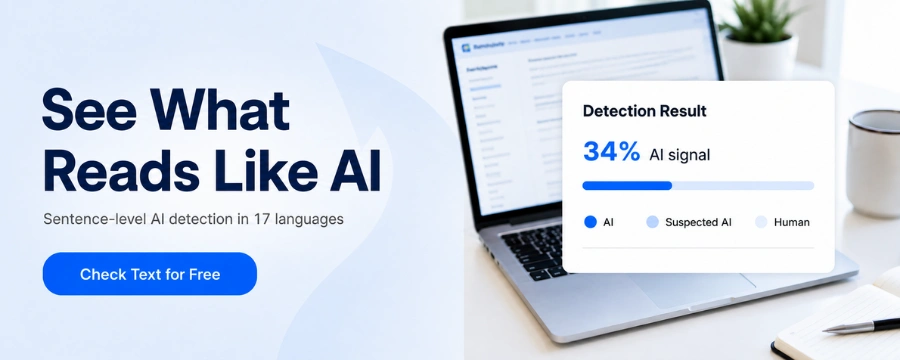
After analyzing the text, a detector combines its signals into a prediction. It may display a percentage, category, or sentence-level result.
An 80 percent AI score does not necessarily mean that AI wrote exactly 80 percent of the document. It may indicate that the text strongly resembles patterns the detector associates with AI-generated writing.
A sentence can receive a high AI likelihood while the complete document receives a lower score. The surrounding paragraphs may contain different writing patterns.
Scores from separate platforms are not directly interchangeable. Each tool can use different training data, thresholds, labels, and calibration methods. Users should review how a specific detector defines its output before comparing percentages.
Why AI Detectors Can Be Wrong
AI detection works under uncertainty. Several factors can cause false positives or false negatives.
| Factor | Why it affects detection |
|---|---|
| Short text | Fewer sentences provide less evidence about vocabulary, structure, and rhythm |
| Human editing | Rewriting or combining AI output with original content changes detectable patterns |
| Language | A detector may have stronger training coverage in some languages than others |
| Writing domain | Technical, legal, academic, and formulaic content may differ from the training data |
| New AI models | A detector trained on older outputs may not recognize newer writing patterns |
| Predictable human writing | Templates and structured reports can resemble statistically regular AI text |
Grammar tools add another challenge. A document may begin as human writing but include AI-assisted corrections or rewritten sentences. The detector usually cannot reconstruct that process from the final version alone.
These limitations do not make every result useless. They mean the score should be interpreted as one signal rather than conclusive proof.
AI Detection Compared With Plagiarism Detection
AI detection and plagiarism detection answer different questions.
| Comparison | AI detection | Plagiarism detection |
|---|---|---|
| Main question | Does the text resemble AI-generated writing | Does the text match an existing source |
| Typical method | Linguistic and statistical classification | Source and phrase matching |
| Common result | Probability, label, or highlighted passages | Matching text and possible sources |
| Main limitation | Cannot prove authorship | May miss uncatalogued or heavily rewritten sources |
AI-generated text may not match any published source. Human-written content can also include copied material.
An AI detector therefore does not replace plagiarism checking, citation review, or fact-checking.
How to Use AI Detection Results Responsibly
A detection result should begin a review rather than end it.
- Review the complete document and any highlighted passages
- Compare the result with drafts, version history, research notes, and earlier writing
- Consider the language, subject, text length, and editing process
- Give the writer an opportunity to explain how the document was created
Testing the same text with another detector may provide an additional perspective. Agreement between several tools still does not prove authorship because they may rely on similar patterns.
For high-stakes decisions, detection results should be considered alongside stronger evidence. Academic and workplace policies should also explain how these tools are used and how a person can question a result.
If you want to review your own content, the Unfox AI Content Detector can help identify passages that resemble AI-generated writing. Its result should still be interpreted within the wider context of the document.
What AI Detectors Cannot Prove
An AI content detector generally cannot establish:
- Which language model produced the text
- What percentage of the document involved AI
- Whether AI was used only for editing
- Whether the content contains plagiarism
- Whether its claims are factually correct
- Whether the author violated a specific policy
- Whether a flagged score justifies a penalty
Answering these questions requires additional information. A detection score alone is not definitive.
Final Takeaway
AI content detectors compare linguistic, statistical, and contextual patterns with examples learned during training. Common signals include token probability, perplexity, sentence variation, vocabulary, style, and semantic relationships.
Results can vary by model, prompt, language, text length, subject, editing, and detector. Unfox AI can provide a useful signal when you want to examine your own content, but the result works best when combined with context, supporting evidence, and human judgment.
FAQ
Can AI Detectors Identify ChatGPT Text
AI detectors may recognize patterns associated with ChatGPT and similar models. Results depend on the model version, prompt, text length, language, and editing. A positive result does not prove that ChatGPT produced the content.
Are AI Content Detectors Accurate
AI detectors can provide useful signals, but false positives and false negatives remain possible. Performance varies according to the tool, training data, evaluation method, language, and type of writing.
Can Human-Written Text Be Flagged as AI
Yes. Structured, formal, repetitive, or predictable human writing may resemble AI-generated text. Short passages and content outside the detector’s training data can also be harder to classify.
Does Editing AI Text Affect Detection
Editing can change vocabulary, structure, rhythm, and predictability. Substantial rewriting may affect the result more than minor grammar corrections, although individual results may vary.
Why Do AI Detectors Give Different Results
Different detectors use different models, training data, features, thresholds, and scoring methods. Their percentages may not represent the same measurement, so direct comparisons require caution.