
An AI detector false positive occurs when a tool classifies human-written text as AI-generated. The system has identified patterns associated with AI writing even though a person actually wrote the text.
These patterns are not exclusive to AI-generated content. Predictable vocabulary, formal language, structured sentences, short samples, language background, and extensive editing can all affect classification.
A false positive therefore does not automatically show that a detector is useless. It shows that a detection result needs to be interpreted within the conditions under which it was produced.
What Is an AI Detector False Positive?
A false positive occurs when the actual text is human-written but the detector predicts that it was generated by AI.
The opposite error is a false negative, where AI-generated text is classified as human-written.
| Actual text | Detector result | Outcome |
|---|---|---|
| Human-written | Human | Correct classification |
| Human-written | AI-generated | False positive |
| AI-generated | AI-generated | Correct classification |
| AI-generated | Human | False negative |
Both errors matter, but their consequences depend on the use case. A false positive in an academic setting can lead to unnecessary scrutiny, while a false negative can allow AI-generated work to pass through a detection workflow.
The key limitation is that a detector does not directly observe authorship. It evaluates properties of the submitted text and uses them to produce a classification or score.
How Do AI Detectors Decide That Text Looks AI-Generated?
Detection systems use different approaches, and commercial providers do not necessarily disclose every feature in their models.
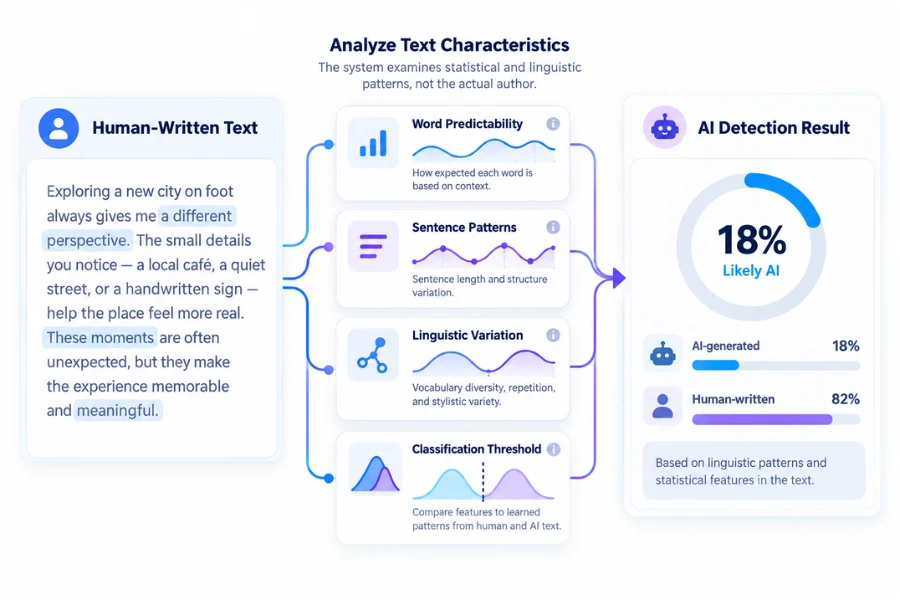
Some approaches examine signals related to word predictability, sentence patterns, or linguistic variation. Commercial systems may combine these with additional learned or proprietary features.
It is therefore too simplistic to assume that every AI detector works through the same combination of perplexity and burstiness.
Word Predictability and Perplexity
Perplexity describes how predictable a sequence of words is to a language model.
Text with highly predictable word choices can have lower perplexity, while less predictable sequences can have higher perplexity. Some detection research has examined this type of signal because generated and human-written text can exhibit different statistical characteristics.
Low perplexity does not prove that AI wrote a passage.
Human writers can naturally use familiar vocabulary and predictable phrasing. A student following an academic structure, a professional following a style guide, or a writer working in a second language may produce relatively predictable text.
A 2023 study by Liang and colleagues found substantial false-positive rates on a specific set of TOEFL essays written by non-native English speakers and examined linguistic characteristics associated with those classifications.
Sentence Variation and Other Signals
Some detection approaches also examine variation across sentences and passages.
Human writing can vary considerably in sentence length and structure, but it can also be highly consistent when the genre requires precision or repetition. Technical documentation, research abstracts, reports, instructions, and structured essays often use conventional patterns for legitimate reasons.
Classification Thresholds
A detector needs a decision boundary that determines when its evidence is strong enough to classify text as AI-generated.
Changing that threshold affects the balance between false positives and false negatives. A more sensitive setting may identify more AI-generated text while increasing the number of human passages that are flagged. A more conservative setting can reduce false positives while allowing more AI-generated text to pass undetected.
The RAID benchmark illustrates why this balance cannot be evaluated under only one set of conditions. It tested detectors across more than 6 million generated samples, 11 models, eight domains, and multiple adversarial and decoding conditions, finding that detector performance changed when those conditions changed.
The practical implication is that detector performance is conditional rather than a fixed property that applies equally to every text.
Why Do AI Detector False Positives Happen?
Different types of human writing can produce different signals. Several conditions are especially relevant.
Predictable and Structured Writing
Writers who use straightforward vocabulary, conventional transitions, consistent grammar, and repeated sentence structures can produce text with relatively low statistical variation.
Those characteristics may overlap with patterns associated with generated text, even when the writing is entirely human.
Academic and Formulaic Writing
Academic and professional genres often impose predictable structures.
A laboratory report may follow a required sequence. A scientific abstract may use conventional phrasing. A technical manual may repeat grammatical patterns across many sections.
The predictability is a property of the genre, not evidence that the text was generated by AI.
Non-Native English Writing
Language background is an important case because research has documented uneven detector performance across some writer populations.
Liang and colleagues evaluated seven GPT detectors using 91 TOEFL essays written by non-native English speakers and 88 essays written by US eighth-grade students. In the TOEFL sample, the average false-positive rate across the seven detectors was 61.3 percent, and at least one detector classified 97.8 percent of those essays as AI-generated.
That does not mean current AI detectors have a universal 61.3 percent false-positive rate for non-native English writers. The result came from a specific dataset, detector set, and evaluation design.
Later evaluations have also shown that the size and direction of language-related effects can vary across detectors, corpora, and languages. The 2023 finding is therefore important evidence of a specific failure mode, not a universal demographic rule.
Short Text
Short passages provide fewer sentences and linguistic patterns for a detector to evaluate.
A short answer can therefore be more sensitive to individual wording choices than a longer document. This does not establish that every short sample is unreliable, but text length is an important condition when interpreting a score.
Turnitin currently requires at least 300 words of qualifying prose for its AI Writing Report and excludes certain non-prose formats from reliable AI detection.
Editing and Language Correction
Editing can change measurable characteristics of writing.
A writer may produce a rough draft with uneven phrasing and then apply grammar correction, copyediting, translation, or style revisions that make the final version more consistent.
The detector sees the final text, not the sequence of revisions that produced it. Version history can therefore provide information about authorship that the detection system itself cannot observe.
Why Do AI Detector False Positive Rates Vary So Much?
There is no single false-positive rate that applies to every AI detector, writer, and type of text.
| Factor | Why it can matter |
|---|---|
| Detector | Different systems can use different models, signals, and training data |
| Threshold | The decision boundary affects false positives and false negatives |
| Text length | Shorter samples provide less textual evidence |
| Language | Performance can vary across languages and writer populations |
| Genre | Formulaic writing can overlap with AI-associated patterns |
| Editing | Revision can change measurable writing characteristics |
| Dataset | The composition of the test set affects the reported result |
| Model version | Detection systems can change after updates |
| Evaluation method | Vendor and independent tests can use different conditions |
Consider a simple example.
If a detector evaluates 1,000 human-written documents and incorrectly flags 10, the observed false-positive rate is 1 percent. If another evaluation contains 100 difficult human-written samples and 10 are incorrectly flagged, the observed rate is 10 percent.
The difference does not necessarily mean that the detector became ten times less accurate. The samples and evaluation conditions changed.
Base Rates Matter at Scale
A low false-positive rate can still produce a meaningful number of false flags when a system is used on a large population.
For example, if a 1 percent false-positive rate applied to 10,000 qualifying human-written submissions under the same conditions, approximately 100 could be incorrectly flagged.
That does not mean 100 false positives will occur in every real-world group of 10,000 documents. It illustrates why a rate that looks small in isolation can become consequential when automated detection is applied at scale.
This is particularly important for systems used in education, publishing, hiring, or other settings where a false flag can trigger further investigation.
What Research Says About AI Detector False Positives
Research shows that detector performance can vary substantially, but it does not establish one universal accuracy figure.
The Stanford Study on Non-Native English Writing
The 2023 Patterns study by Liang and colleagues evaluated seven GPT detectors using human-written TOEFL essays from non-native English speakers and a separate set of US eighth-grade essays. The detectors produced substantially more false positives on the TOEFL essays.
The researchers also found that changing vocabulary could affect detection outcomes.
The useful conclusion is not that every detector behaves the same way today. It is that linguistic characteristics can affect classification and that results from one population should not automatically be generalized to every writing situation.
The RAID Benchmark
RAID evaluated AI text detectors across more than 6 million generated samples, 11 models, eight domains, and multiple adversarial attacks and decoding strategies. It found that detectors could struggle when they encountered unseen models, different sampling conditions, repetition penalties, and adversarial modifications.
The broader lesson is that detector performance depends partly on the conditions represented in its evaluation data.
Vendor Benchmarks Need Context
Commercial providers also publish accuracy and false-positive figures.
These results can be useful, but they describe the datasets and testing methodology used by the provider. They should not automatically be treated as universal performance guarantees.
Turnitin's current documentation states that its AI writing model may misidentify human-written, AI-generated, or AI-paraphrased text and says the report should not be used as the sole basis for adverse action against a student.
Turnitin also does not surface exact AI percentages from 1 percent through 19 percent. Instead, it displays an asterisk because results in that range have a higher incidence of false positives.
This illustrates an important point. Even a commercial detection system can build uncertainty into how low-confidence results are reported.
What the Evidence Does Not Show
The available research does not establish one universal false-positive rate for all AI detectors.
It also does not show that every detector has the same bias, or that detector scores are useless in every context.
The stronger conclusion is narrower and more defensible.
AI detection results need to be interpreted in relation to the detector, text, dataset, evaluation conditions, and decision being made.
Is an AI Detector Score a Probability?
Not necessarily.
If a tool reports that 80 percent of a document is AI-generated, that does not automatically mean there is an 80 percent probability that AI wrote the document.
A reported percentage could represent the proportion of text classified as AI, a confidence measure, a classification score, or another proprietary metric. A calibrated probability is a separate statistical concept.
The exact meaning depends on how the individual system defines and calculates its score.
This distinction matters because the detector evaluates text characteristics rather than directly observing the author's identity.
Why Do Different AI Detectors Give Different Results?
One detector might give a passage an 80 percent AI score while another gives it 15 percent.
Different systems can use different models, training data, statistical signals, thresholds, and calibration methods. Their evaluation datasets may also represent different languages, genres, and text lengths.
Using multiple detectors can provide additional context, but it should not become a simple majority vote.
Running the same passage through five tools does not automatically create five independent pieces of evidence. Different systems can respond to similar writing patterns or share related assumptions.
Even if several tools agree, their agreement remains a set of model classifications rather than direct evidence of who wrote the text.
What Should You Do If Your Human-Written Text Is Flagged?
If you wrote the text yourself, the most useful response is usually to preserve evidence of the writing process rather than trying to manipulate the detector score.
Keep the Original Text
Save the version that was evaluated.
Do not immediately rewrite it simply to obtain a different detection result. The original provides a stable record of what was actually assessed.
Preserve Your Writing History
Useful evidence can include:
Earlier drafts
Document version history
Outlines
Research notes
Source annotations
Tracked changes
Revision records
This evidence provides information about the writing process that an automated detector cannot observe.
Review the Flagged Sections
If the detector identifies specific passages, examine those sections rather than focusing only on the overall score.
Look for characteristics that may explain the classification, such as highly formulaic wording or unusually consistent sentence structures.
The goal is to understand why the system produced the result, not to make the text artificially harder to detect.
Consider Another Assessment
A second detector can provide another data point.
If two systems disagree, that disagreement is evidence that the classification is sensitive to the detection method. If several systems agree, it may justify closer review, but agreement alone does not establish authorship.
Request Human Review When the Stakes Are High
For academic or professional disputes, automated detection should be considered alongside other evidence.
Turnitin's current guidance recommends further scrutiny and human judgment rather than treating its AI writing report as the sole basis for adverse action.
A human reviewer can consider the writing history, assignment context, previous work, research process, and other relevant evidence.
Can You Reduce the Risk of a False Positive?
You cannot reliably eliminate false positives by changing a few writing habits.
Deliberately rewriting human work to manipulate a detector can also make the writing less natural while doing nothing to establish authorship.
A more useful objective is to make the writing process easier to verify.
Keep drafts as you work. Preserve version history. Save research notes and outlines. If someone edits your work, keep a record of what was changed.
You do not need to insert awkward wording, unnecessary mistakes, or random sentence structures to make human writing appear less predictable.
How Should AI Detection Results Be Used?
An AI detector is best treated as a screening signal rather than an authorship verdict.
A low score means the system found relatively few AI-associated patterns. It does not prove that the text is entirely human-written.
A high score means the system found stronger AI-associated patterns. It does not independently prove that AI generated the text.
A conflicting result indicates that different systems classified the same text differently.
The appropriate weight of a detector result depends on the decision. A screening check for a low-stakes workflow is different from using an AI score as evidence in an academic misconduct or employment dispute.
For high-stakes decisions, detector output should be considered alongside evidence about the writing process and the context in which the text was produced.
Can AI Detectors Be Trusted?
AI detector accuracy and reliability depend on the detector, the text being evaluated, the test conditions, and how the result is used.
AI detectors can be useful when their role is clearly defined. They can identify text that resembles patterns associated with machine-generated writing and can help direct attention toward passages that deserve further review.
They are less suitable as standalone proof of authorship.
OpenAI's discontinued AI Text Classifier illustrates why performance should be measured rather than assumed. OpenAI discontinued the classifier in July 2023 because of its low accuracy. In its published evaluation, the classifier correctly identified 26 percent of AI-written text as likely AI-written while incorrectly labeling human-written text as AI-generated 9 percent of the time on its challenge set.
That historical result does not describe every current detector. It demonstrates that detector performance can be substantially different from what a simple “AI detector” label might imply.
Detection systems also continue to change. Turnitin has released multiple model updates, including 2026 updates intended to improve detection performance while maintaining attention to false-positive rates.
The defensible conclusion is therefore not that AI detectors are accurate or inaccurate in general.
Their usefulness depends on the detector, the text, the evaluation conditions, and how much weight the result is given.
Final Takeaway
AI detector false positives occur because AI-associated writing patterns are not exclusive to AI-generated text.
Human writers can naturally produce predictable, structured, formal, or highly edited language. Research has also shown that detector performance can vary across writer populations, languages, models, domains, and evaluation conditions.
The false-positive rate is therefore not a universal number, and a detector percentage should not automatically be interpreted as the probability that AI wrote a document.
If human-written work is flagged, preserve the original and its writing history, examine the relevant passages, and request human review when the consequences are significant.
If you want another screening signal before submitting or publishing your work, you can also try Unfox AI. Treat its result as one piece of information alongside your writing process and the context in which the text was created.
FAQ
What does a false positive mean in AI detection?
A false positive occurs when an AI detector identifies human-written text as AI-generated. The result means the text matched patterns associated with AI writing, not that the detector directly verified who wrote it.
Why did an AI detector flag my human-written essay?
Human writing can contain predictable vocabulary, consistent grammar, structured sentence patterns, or formulaic language. Academic writing, language background, short samples, and editing can also affect how some detection systems classify text.
Is an AI detector score a probability?
Not necessarily. A detector percentage may represent the proportion of text classified as AI, a confidence measure, or another proprietary metric. It should not automatically be interpreted as the probability that AI wrote the text.
What is a good false positive rate for an AI detector?
There is no universal rate that applies to every detector or type of writing. False-positive results depend on the detector, dataset, threshold, language, text type, text length, model version, and evaluation method.
Can a high AI detection score prove that someone used AI?
No. A high score means that the detector found patterns it associates with AI-generated text. It does not independently establish authorship or prove that AI was used.
Why do different AI detectors give different scores?
Different detectors can use different models, training data, statistical signals, thresholds, and calibration methods. They may also perform differently across languages, genres, and text lengths.
Are non-native English writers more likely to be flagged?
Some research has found substantially higher false-positive rates for non-native English writing under specific evaluation conditions. The widely cited 2023 Liang et al. study found an average false-positive rate of 61.3 percent across seven detectors on 91 TOEFL essays, but that result should not be treated as a universal rate for all detectors or all non-native English writers.
What should I do if my human-written work is flagged?
Keep the original document, preserve drafts and version history, review the relevant passages, and consider another assessment for additional context. If the result could lead to a significant academic or professional consequence, request a human review that considers evidence beyond the detector score.