
AI image detectors can be useful, but there is no single accuracy rate that applies to every detector or image. Performance changes with the detector, training data, image generator, image type, editing, compression, and test dataset.
A large 2026 benchmark covering roughly 2.6 million images illustrates the variation. The strongest tested method achieved about 75% mean accuracy across datasets, but that figure describes one benchmark rather than AI image detectors as a whole.
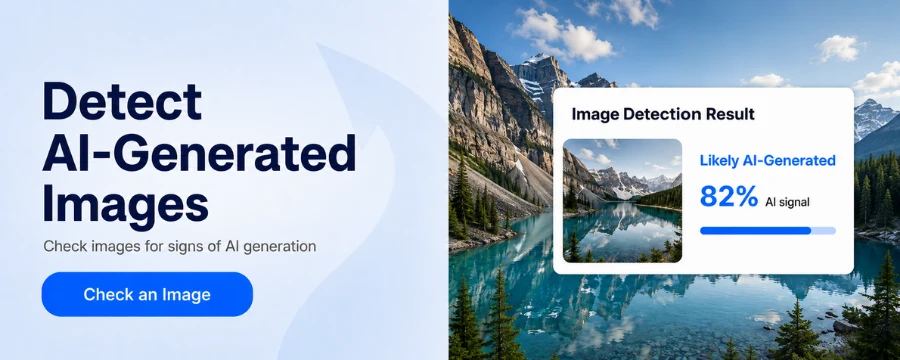
Why AI Image Detector Accuracy Varies So Much
AI image detection tools may advertise accuracy rates of 95%, 98%, or higher while independent benchmarks produce much lower numbers. The figures are not directly comparable unless the tests use similar images, generators, processing conditions, and evaluation metrics.
A detector tested mainly on generators represented in its training data faces a different task from one evaluated against hundreds of unfamiliar generators. Clean original files also create different test conditions from resized, compressed, or edited images.
Before trusting an accuracy claim, check:
How many images were tested?
How many were real and how many were AI-generated?
Which image generators were included?
Were unfamiliar generators tested?
Were the images edited or compressed?
How often were real images incorrectly classified as AI?
Without these conditions, an accuracy percentage provides limited evidence about how the detector will perform on your image.
What Does AI Image Detector Accuracy Actually Mean?
Suppose a detector is evaluated on 500 AI-generated images and 500 real images. It correctly identifies 490 AI images, giving it a 98% detection rate on the AI-generated portion of the test.
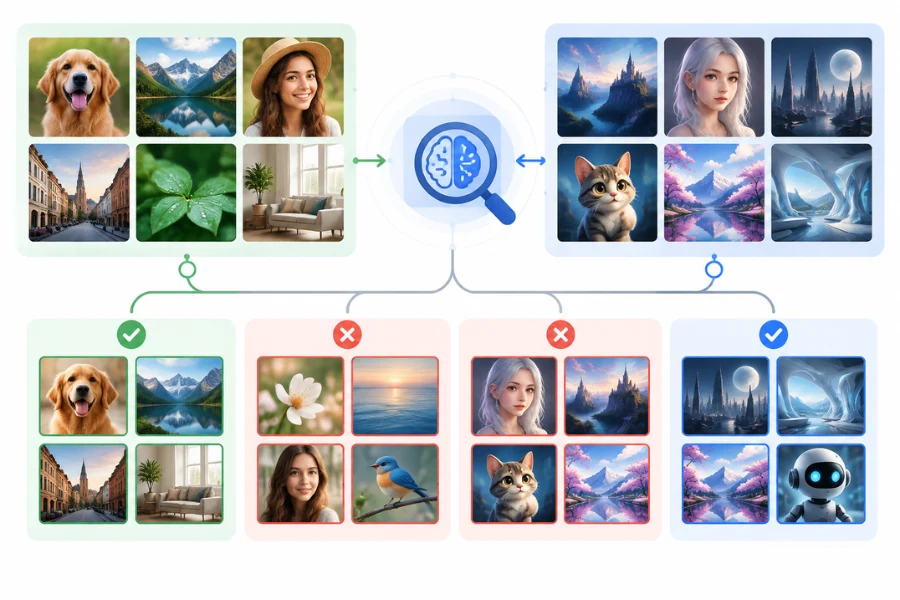
If it also incorrectly flags 100 of the 500 real photographs as AI-generated, that 98% detection rate no longer describes the detector's overall reliability.
| Metric | What It Tells You |
|---|---|
| Accuracy | How many total classifications were correct |
| Precision | When the detector says AI, how often it is correct |
| Recall | How many actual AI images the detector successfully identifies |
| False-positive rate | How often real images are incorrectly flagged as AI |
| False-negative rate | How often AI-generated images are incorrectly classified as real |
Why False Positives and False Negatives Matter
A false positive occurs when a real image is classified as AI-generated. A false negative occurs when an AI-generated image is classified as real.
The importance of each error depends on the decision being made. Missing an AI-generated profile picture may have limited consequences, while incorrectly labeling a journalist's photograph, a student's work, or a creator's image as AI-generated can affect attribution or credibility.
A useful accuracy assessment therefore needs to show not only how many AI images were detected, but also how often authentic images were misclassified.
What Independent Tests Tell Us
A 2026 zero-shot benchmark evaluated 16 detection methods and 23 pretrained variants across 12 datasets, covering roughly 2.6 million images from 291 generators.
The strongest method reached about 75% mean accuracy across datasets. Performance varied substantially between datasets, and changing the training data produced large differences even when the underlying detector architecture was similar.
These results show a generalization problem. Patterns that separate AI and real images in one training distribution may not work equally well across unfamiliar generators and datasets.
New Image Generators Create a Generalization Problem
The same benchmark found that modern generators including FLUX, Firefly, and Midjourney were particularly difficult for many tested detectors. Across the 291 generators, dozens produced average detection rates below 50%.
A detector can therefore perform well against generators represented in an existing benchmark and perform much worse on a newer or unfamiliar generator. When evaluating an accuracy claim, generator coverage matters alongside the headline percentage.
Why Does AI Image Detector Accuracy Change?
Several variables determine whether patterns learned during training remain useful for the image being tested.
The Image Generator
Midjourney, FLUX, Stable Diffusion, and other generators use different models and generation pipelines. Their outputs can contain different statistical patterns, so a detector may recognize images from some generators more reliably than others.
The Training Data
AI image detectors learn their classification boundaries from examples. Training on a broader range of real images, generators, styles, and processing conditions may improve generalization beyond a narrow dataset, although diversity alone does not guarantee strong performance.
Compression, Resizing, and Editing
The file submitted to a detector may be several steps removed from the original.
An image can be saved as JPEG, uploaded to a social platform, recompressed, cropped, resized, filtered, or captured as a screenshot. These transformations can alter information available to the detector, although the effect depends on the transformation and detection method.
Compression or resizing does not automatically defeat AI detection. It does mean that performance measured on clean benchmark files may not transfer directly to processed versions.
When possible, test the highest-quality original available rather than a screenshot or repeatedly recompressed copy. This removes unnecessary transformations between the source file and the detector.
The Type of Image
Digital illustrations, heavily processed photographs, computer graphics, and highly polished studio images may not resemble the real photographs used in a detector's evaluation dataset.
If an image falls outside the distributions represented during training and testing, the risk of false positives or false negatives can change. This is another reason benchmark composition matters when interpreting accuracy claims.
Fully Generated and AI-Edited Images Are Not the Same
Consider four files:
A completely AI-generated portrait
A real photograph with a generative background
A photo where an object was added using generative fill
A real photo enhanced using an AI editing feature
AI was involved in all four, but the role of AI is different in each case.
Asking whether AI was involved is therefore not the same as asking whether the entire image was AI-generated. Detectors may also define or classify this boundary differently, which can contribute to disagreement on partially edited images.
Why False Positives Deserve Special Attention
NewsGuard tested five AI image detection tools using 15 authentic news photographs in 2026. Some tools incorrectly classified authentic photographs as AI-generated, while others made no false-positive errors on this particular sample.
Fifteen images are not enough to establish a universal false-positive rate for any detector. The test instead demonstrates why an accuracy benchmark needs authentic images as well as generated ones.
The acceptable error tradeoff also depends on the use case. Broad content screening may prioritize catching more generated images, while decisions that could challenge the authenticity of a journalist's photograph or creator's work require greater attention to false positives.
What Does a 90% AI Score Actually Mean?
A result such as "90% AI" should not automatically be interpreted as an objective 90% probability that the image was generated by AI.
Depending on the detector, the number may represent model confidence, a normalized classification score, or another measure derived from its prediction system. Its meaning also depends on how that score was designed and calibrated.
A high score indicates strong evidence according to that detector's model. It does not independently establish how the file was created.
Scores close to a detector's decision threshold require particular caution. A 49% and 51% result may fall on opposite sides of a binary label while remaining close in the underlying score, so other evidence becomes more important near the boundary.
AI Detection Is Not the Same as Image Provenance
AI detectors, watermarks, and provenance systems answer different questions.
| Method | What It Can Tell You | Main Limitation |
|---|---|---|
| AI image detector | Whether image patterns resemble AI-generated content | The result is probabilistic |
| AI watermark | Whether a supported embedded signal can be detected | Not every generator uses the same watermark |
| Content Credentials | Available information about provenance and editing history | Credentials may not exist for the file |
Systems such as Google's SynthID embed an imperceptible signal into supported AI-generated content. C2PA-based Content Credentials instead record provenance information that can travel with supported content.
A detector estimates origin from patterns in an image. Provenance can document aspects of origin or editing history when trustworthy provenance data is available. Neither approach covers every image or guarantees that the information needed for verification will be present.
How to Get a More Reliable AI Image Detection Result
Use the best-quality file available. Test the original file when possible instead of a screenshot or repeatedly compressed copy.
Interpret the score, not just the label. A confidence indicator can show whether a classification is strong or close to the detector's decision boundary, provided you understand what that detector's score represents.
Check independent evidence. Content Credentials, supported watermarks, metadata, source history, and known editing history can provide information that visual classification alone cannot.
Compare evidence when the decision matters. A second detector can provide another signal, but agreement between two tools does not prove an image's origin because the tools may still share similar limitations.
Are AI Image Detectors Reliable Enough to Use?
AI image detectors are useful as evidence, but current research does not support treating their predictions as standalone proof of an image's origin.
Reliability depends on how closely the tested image matches the generators, image types, and processing conditions represented in the detector's training and evaluation data. The consequences of false positives and false negatives also determine which performance metrics matter most for a particular use case.
For routine checks, a detector can provide a fast first assessment. For consequential decisions, combine the result with provenance, source information, and editing history.
If you have an image you are unsure about, you can use the Unfox AI Image Detector as one signal and interpret its result alongside the other evidence available.
FAQ
Can AI Image Detectors Be Wrong?
Yes. AI image detectors can produce false positives and false negatives. Error rates vary with the detector, generator, image type, training data, and processing applied to the image.
Can AI-Generated Images Avoid Detection?
Yes. False negatives can occur when a detector encounters generators or image distributions that differ from those represented in its training data. Image transformations may also change the signals available for detection, although their effect varies.
Can Real Photos Be Flagged as AI-Generated?
Yes. This is a false positive. A real photograph can fall on the AI-generated side of a detector's classification boundary, so a detector result alone should not be treated as proof that a photograph is synthetic.
Does Editing an AI Image Affect Detection?
It can. Cropping, resizing, compression, filters, generative editing, and other transformations can change information available to a detector. The effect depends on both the modification and the detection method.
Why Do AI Image Detectors Give Different Results?
Detectors can differ in training data, model architecture, generator coverage, scoring methods, and decision thresholds. The same image can therefore receive different classifications without either result independently proving its origin.
Is a 90% AI Score Proof That an Image Is AI-Generated?
No. The score reflects evidence according to that detector's scoring system. Its exact meaning depends on how the score is defined and calibrated, so consequential decisions should also consider provenance, source information, and editing history.