
You can detect possible AI-generated text by combining an AI detector with manual checks for language patterns, factual accuracy, citations, and writing context.
The important word is possible. No single phrase, writing habit, or detector score can conclusively prove that a text was written by ChatGPT or another AI model.
For a practical check, start with an AI content detector such as Unfox AI, then review the text yourself. The more important the decision, the more supporting evidence you should consider.
How to Detect AI-Generated Text Step by Step
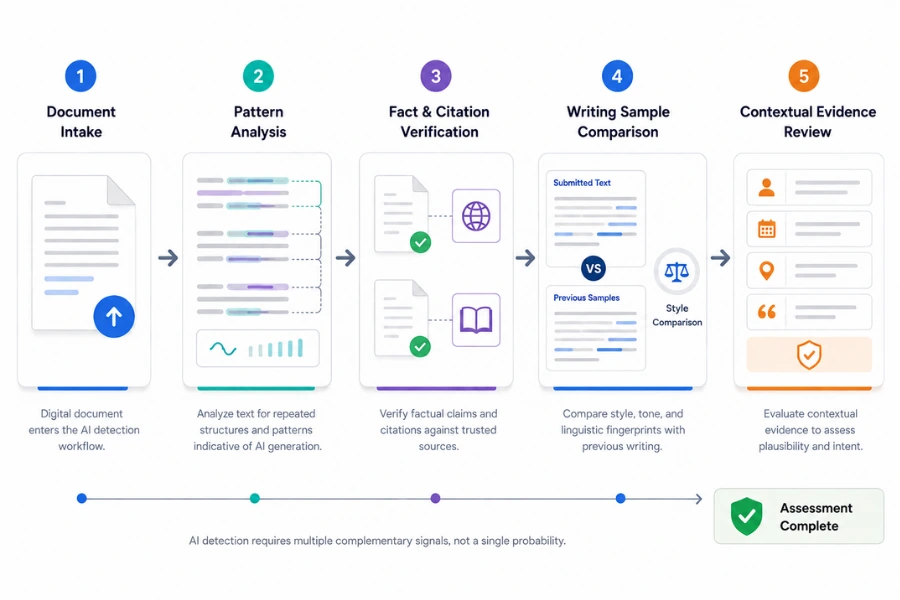
You do not need to analyze every sentence like a linguist. A simple five-step process can help you identify text that deserves closer review.
1. Check the Text With an AI Detector
Start by running a sufficiently long sample through an AI detector.
A tool such as Unfox AI can provide an initial signal about whether the writing resembles patterns associated with AI-generated text. Depending on the detector, results may be presented as classifications, scores, or highlighted sections.
Treat that result as a starting point. Short samples usually provide less information for classification, and different detectors may produce different results.
2. Look for Repeated Writing Patterns
Read the text and look for patterns that appear unusually often.
These may include repeated sentence structures, similar paragraph openings, highly consistent sentence lengths, or the same transition patterns appearing throughout the article.
AI can produce this kind of regularity, but so can human writers using templates or formal writing conventions. Repetition becomes more useful as a clue when it appears alongside other signals.
3. Look for Specific Information
Ask whether the writing provides concrete information or mainly sounds informative.
Some AI-generated passages rely heavily on broad claims about something being important, effective, innovative, or influential without explaining exactly why.
Names, dates, technical details, firsthand observations, and verifiable examples give you more evidence to examine. A lack of specifics is not proof of AI use, but consistently generic writing deserves closer review.
4. Verify Facts and Citations
Check statistics, studies, quotations, dates, and references that can be independently verified.
Confirm that cited sources actually exist and support the claims attached to them. AI models can produce incorrect information or plausible-looking references, although human writers can make these mistakes too.
The goal is to identify evidence that needs further investigation, not to treat every incorrect citation as an AI fingerprint.
5. Compare the Evidence
Do not make the final judgment from one clue.
A useful workflow is
AI detector → writing patterns → factual verification → writing history → context
When several independent signals point in the same direction, closer investigation may be reasonable. When the evidence conflicts, the most accurate conclusion may simply be uncertain.
What Are the Signs of AI-Generated Text
There is no universal checklist for identifying AI writing. Large language models learn from human-created text, so AI and human writing naturally share many characteristics.
Still, several patterns can help you decide where to look more closely.
Repetitive Sentence Structures
AI-generated writing can sometimes fall into recurring templates.
Several paragraphs might use similar openings, sentence rhythms, transitions, or conclusions. Lists may repeatedly follow the same structure.
Look for clusters of these patterns rather than one isolated example.
Generic Language With Few Specifics
One useful clue is the difference between language that sounds meaningful and information that actually tells you something.
Consider these examples.
The project played a crucial role in shaping the industry's evolving landscape.
The company opened its second production line in 2024 and added 18,000 units of monthly capacity.
The first could apply to many situations. The second contains claims that can be checked.
Human writers can also be vague, so specificity is a review signal rather than a test of authorship.
Repeated AI-Associated Vocabulary
Some language models may overuse particular words or constructions.
Words such as highlighting, showcasing, crucial, enhance, and underscore have been associated with patterns observed in AI-generated writing.
But these are ordinary English words. Finding crucial in a paragraph tells you almost nothing by itself.
Model behavior also changes over time. Static lists of supposed "AI words" can therefore become misleading quickly.
Unusually Uniform Tone
Some AI outputs maintain a very consistent tone, sentence rhythm, and paragraph structure across long passages.
That uniformity can make the writing feel polished but impersonal.
Professional, academic, and technical writers may deliberately write consistently, however. Tone should therefore be compared with other evidence rather than judged alone.
Vague or Unsupported Attribution
Watch for statements such as "experts suggest," "studies show," or "industry reports indicate" when no identifiable source follows.
This does not prove AI authorship. It does tell you that the claim needs verification.
The same applies to references that look credible but lead to nonexistent studies, incorrect authors, or sources that do not support the claim.
How AI Detectors Detect AI Writing
AI-generated text detection can be understood as a classification problem.
The system analyzes a piece of writing and estimates whether its characteristics more closely resemble patterns associated with AI-generated or human-written examples.
Text Classification and Learned Patterns
One machine learning approach converts text into numerical representations called embeddings. A classifier can then learn relationships between those representations and labeled examples.
Models can also be fine-tuned for specific classification tasks using collections of labeled data.
These concepts help explain how text classification can work. They should not be interpreted as the exact internal architecture of Unfox AI or every commercial AI detector, since detection systems may use different models and methods.
Statistical Predictability and Perplexity
Perplexity is another concept frequently discussed in AI text detection.
In simplified terms, perplexity measures how surprising or difficult a sequence of text is for a language model to predict. Some machine-generated text can show relatively predictable statistical patterns.
However, low perplexity does not mean a text was generated by AI.
Human-written legal documents, standardized reports, academic passages, and other formulaic writing can also be highly predictable. Generation settings can also change the predictability of AI output.
Perplexity is one possible signal rather than proof of authorship.
Can You Detect ChatGPT Writing Just by Reading It
You may notice clues, but reading style alone generally cannot establish that ChatGPT wrote a text.
A useful manual review focuses on combinations of signals.
| Possible clue | What it may suggest | Why it is not proof |
|---|---|---|
| Repeated phrasing | Formulaic writing | Humans repeat phrases |
| Uniform sentence rhythm | Predictable structure | Formal writing can be uniform |
| Generic explanations | Limited specificity | Humans can also write broadly |
| Repeated AI-associated words | Worth closer review | They are ordinary words |
| Incorrect citations | Requires verification | Humans make citation errors |
| Sudden style change | Possible outside assistance | Editing can change style |
Why AI Detectors Can Be Wrong
Human and machine writing overlap, which means AI detection involves uncertainty.
A false positive occurs when human-written text is classified as AI-generated. A false negative occurs when AI-generated text is classified as human-written.
Research has demonstrated that these errors can have practical consequences. A 2023 study by Stanford researchers tested seven GPT detectors on human-written essays and found substantial false-positive problems for the non-native English samples in that particular dataset. The authors cautioned against treating low perplexity or detector output as sufficient evidence of AI authorship.
Another 2023 study examining several AI-text detection approaches found that detection performance could deteriorate substantially after recursive paraphrasing. The finding illustrates a broader problem with AI-generated content detection — the statistical distinction between human and machine writing can become harder to identify after the text changes.
Results can also depend on factors such as
- Text length
- Writing style and complexity
- Language
- Content genre
- The AI model that generated the text
- Human editing or rewriting
- The detection model and classification method
This helps explain why different detectors can disagree about the same passage.
How to Use Unfox AI Without Misreading the Result
Using an AI detector is most useful when you separate detection from judgment.
You can paste a writing sample into Unfox AI to get an initial assessment. If the result indicates a stronger AI signal, return to the text and examine the claims, sources, writing patterns, and context that deserve closer attention.
Do not search for a particular score simply to confirm an existing suspicion.
For quick content checks, a detector can help you decide what to review next. For academic, hiring, publishing, or other high-stakes decisions, additional evidence becomes more important.
What to Do When the Result Is Uncertain
Sometimes there simply is not enough evidence to confidently distinguish AI-generated text from human writing.
In education, additional context could include drafts, notes, revision history, previous assignments, and a discussion with the writer.
For professional content, reviewers can examine sources, editorial history, previous writing, and subject-matter knowledge.
This is particularly important when a false positive could have meaningful consequences.
The Best Way to Check AI-Generated Text
The most practical approach combines an AI detector with human review and contextual evidence.
Use Unfox AI for an initial signal, then examine recurring language patterns, verify factual claims and citations, and consider relevant writing history. This approach gives you more context than searching for one definitive "AI tell."
AI detection works best as a process of gathering evidence and evaluating uncertainty.
FAQ
Can AI-Generated Text Be Detected?
AI-generated text can often be identified using detection models and supporting analysis, but results are not definitive. Performance can vary depending on the AI model, text length, language, writing style, editing, and detection tool.
How Can I Check if Text Was Written by AI?
Start with an AI detector such as Unfox AI, then examine writing patterns, specificity, factual claims, citations, and relevant authorship context. Multiple signals provide more useful information than one score.
How Can You Tell if Something Was Written by ChatGPT?
There is no single reliable ChatGPT writing signature. Repetitive structures, generic explanations, uniform tone, recurring vocabulary, and unsupported claims can provide clues, but each can also appear in human writing.
Can AI Detectors Be Wrong?
Yes. AI detectors can produce false positives and false negatives. Different tools may also produce different results for the same text.
Can Human-Written Text Be Flagged as AI?
Yes. Structured or predictable human writing can sometimes resemble patterns associated with AI-generated text. Research has also identified false-positive concerns for some groups and datasets, so results should be interpreted in context.
Can You Detect AI Writing Without a Tool?
You can look for repetitive structures, generic language, questionable citations, unusual consistency, and differences from previous writing. These clues can support a review, but they do not conclusively establish AI authorship.
Is There a 100% Accurate AI Detector?
No detector should be assumed to provide perfect results across every AI model, language, genre, and writing style. AI detection is probabilistic, so the result is better treated as one useful signal rather than conclusive proof.