
Humanizing AI-generated text means editing an AI draft so it reflects your real intent, knowledge, voice, and audience. It takes more than replacing a few formal words or asking AI to “make this sound human.”
A practical approach is to check the meaning first, remove generic language, add specific details, improve sentence rhythm, match the tone to your audience, and bring in examples or insights that actually come from you.
The goal is not to make AI writing artificially imperfect. It is to make the final text clearer, more specific, more natural, and more recognizably yours.
What Does It Mean to Humanize AI-Generated Text
Humanizing AI text means turning a generic AI draft into writing that feels intentional and appropriate for the person communicating it.
That may involve changing sentence structure, vocabulary, tone, pacing, examples, and organization. More importantly, it means adding context, judgment, and original information that AI cannot know unless you provide it.
A good humanized version should preserve the original meaning while improving clarity, specificity, voice, and relevance to the intended reader.
Random synonym replacement is not enough. Neither is deliberately adding grammar mistakes.
Why AI-Generated Text Can Sound Robotic
Large language models generate text based on patterns learned from large amounts of training data. The output also depends heavily on the prompt, context, examples, model, and generation settings.
Modern AI assistants are additionally trained to follow instructions and produce useful responses. As a result, some default outputs can feel unusually organized, cautious, generic, or polished.
These characteristics are not proof that something was written by AI. Human writing varies widely, and AI writing does too.
Prompting also matters. Telling a model to “sound human” gives it little direction. Defining the audience, purpose, tone, format, and preferred writing style gives it a much clearer target.
Common Signs That AI Text Needs Editing
Instead of treating certain words as proof of AI authorship, use recurring patterns as signals that a draft may need another editing pass.
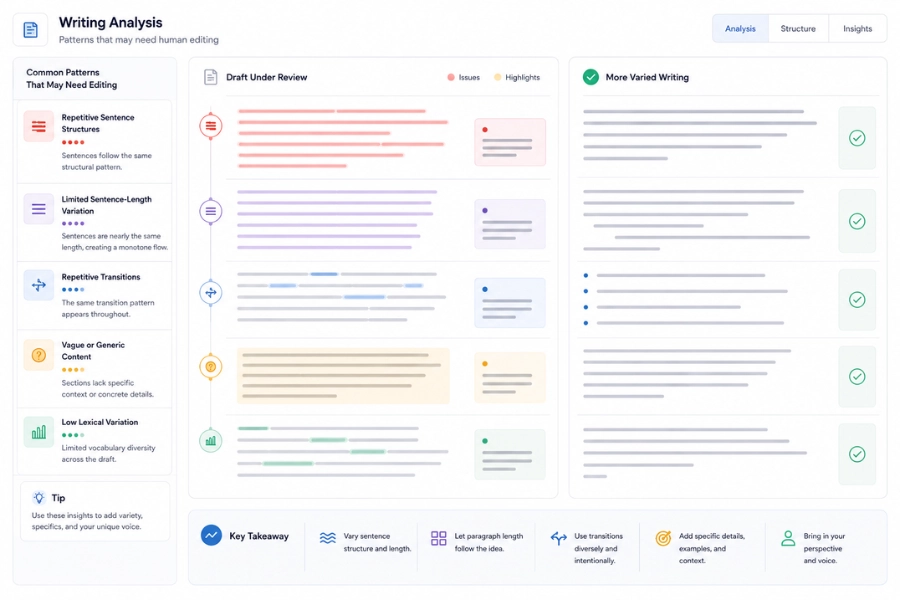
| What You Notice | What to Check |
|---|---|
| Similar sentence structures | Rhythm and pacing |
| Repeated transitions | Flow between ideas |
| Broad claims | Specificity |
| Generic examples | Original details |
| Overly polished wording | Concision |
| Detached tone | Voice and audience |
| Repeated summaries | Unnecessary content |
The useful question is not whether a sentence “looks AI.” Ask whether it communicates the idea as clearly and naturally as it should.
How to Humanize AI-Generated Text Step by Step
1. Check the Meaning Before the Wording
Start by ignoring style.
Ask whether the draft actually says what you mean. Check the main argument, factual claims, examples, assumptions, and conclusions.
Remove irrelevant or unsupported information before rewriting sentences. A polished factual error is still an error.
2. Remove Generic Filler
AI drafts sometimes use complete sentences that add little information.
Instead of
Artificial intelligence is rapidly transforming the way businesses operate in today’s digital world.
Get closer to the actual subject.
AI can draft a customer email in seconds, but the first version may not sound like the person who has to send it.
The second version reaches the reader’s problem faster.
3. Replace Vague Claims With Specific Details
Generic claims often make writing feel interchangeable.
Instead of
AI tools can help teams improve productivity.
Try
A support team can use AI to summarize a long customer ticket before an agent writes the reply.
Specificity gives readers something they can understand and evaluate.
Use real details when possible. Do not invent statistics, experiences, customer stories, or examples just to make a draft appear more authentic.
4. Improve Sentence Rhythm and Flow
Look at several sentences together.
If every sentence has roughly the same length and structure, change the rhythm where it makes sense. Some ideas need a longer explanation. Others work better in a short sentence.
Also check repeated transitions such as “furthermore,” “additionally,” and “moreover.” These are normal English words, but they become distracting when every idea needs an explicit connector.
Do not create variation mechanically. Let the meaning determine the structure.
5. Match the Vocabulary to Your Audience
Natural writing depends on who is reading it.
A technical article for machine learning engineers should not use the same vocabulary as an introductory guide for students. Professional writing also does not need slang to sound human.
Replace unnecessarily formal wording when a simpler expression communicates the same idea. Keep technical terminology when the reader needs it.
6. Add Real Experience and Original Details
This is where human editing can contribute something a generic rewrite cannot.
Add relevant information such as
Something you actually observed
A real example from your work
A decision you made and why
A practical constraint
Data you collected or verified
An opinion you can explain
AI can help express these ideas, but it should not invent them.
If an experience did not happen, do not present an AI-generated story as firsthand knowledge.
7. Build a Consistent Voice
“Make it human” is vague. Define what your voice should actually sound like.
You might choose writing that is professional but conversational, concise but helpful, or technical without becoming academic.
Then review the draft as a whole. A sentence can sound natural by itself while still feeling wrong if it suddenly becomes much more formal, casual, enthusiastic, or promotional than everything around it.
8. Remove Unnecessary Polish
Humanizing does not mean making good writing worse.
AI drafts sometimes state an idea, restate it, explain why it matters, and summarize it again. Keep what helps and cut what does not.
Do not deliberately add spelling errors, awkward grammar, or random slang. Human writing can be polished without sounding mechanical.
9. Read the Draft Aloud
Reading aloud makes awkward pacing easier to hear.
Pay attention to sentences where you stumble, repeated rhythms, stiff transitions, and phrases you would not naturally say.
Sometimes a sentence needs rewriting. Sometimes removing a few unnecessary words is enough.
10. Fact-Check the Final Version
Humanization is still rewriting, and rewriting can change meaning.
Verify important statistics, dates, names, research findings, technical details, comparisons, and qualifications after editing.
If you use an AI humanizer, apply the same rule. Better flow should not come at the expense of accuracy.
Before and After Humanizing AI Text
Consider this AI-style draft.
Original Draft
In today’s rapidly evolving digital landscape, artificial intelligence has become an increasingly important tool for businesses seeking to enhance efficiency and streamline their operations. Furthermore, AI-powered solutions can help organizations optimize workflows, improve productivity, and drive meaningful results.
The grammar is fine, but the paragraph relies on broad claims and generic business language.
Humanized Version
AI is most useful when it removes a specific piece of repetitive work. A support team, for example, might use it to summarize a long customer conversation before an agent responds. That saves the agent from rereading the entire thread while keeping the final reply in human hands.
The improvement does not come from using secret “human words.”
The second version gets to the point faster, uses a concrete scenario, explains what the efficiency gain actually means, and creates more natural sentence variation.
| Change | Why It Helps |
|---|---|
| Removed the generic opening | Reaches the point faster |
| Added a concrete scenario | Makes the claim easier to understand |
| Replaced vague benefits | Adds useful information |
| Varied sentence structure | Improves pacing |
| Removed marketing language | Makes the explanation more direct |
This is an illustrative example, not a formula every paragraph needs to follow.
How to Humanize AI Text With ChatGPT
ChatGPT and other language models can help with rewriting, but the result depends partly on the context you provide.
Instead of asking only for “human writing,” define the audience, purpose, voice, and editing constraints. Providing a short example of your own writing can also give the model a clearer style reference.
Example Prompt for Humanizing AI Text
Rewrite the text below for [audience].
Keep the original meaning and factual claims.
Use a professional, natural, and concise tone.
Remove generic filler, repetitive transitions, and unnecessarily formal wording.
Vary sentence structure naturally without deliberately adding mistakes or slang.
Preserve technical terms the audience needs.
Do not invent facts, statistics, examples, or personal experiences.
Use this short sample as a reference for my preferred writing style.
[Writing sample]
Text to edit
[AI-generated text]
A writing sample can communicate your preferred sentence length, vocabulary, pacing, and formality more clearly than simply telling the model to “sound like me.”
AI Humanizer vs Manual Editing
AI humanizers and manual editing solve overlapping but different parts of the problem.
| Approach | Best For |
|---|---|
| AI humanizer | Faster first-pass rewriting, repetitive phrasing, tone and flow |
| Manual editing | Personal voice, real experience, factual nuance, specialist knowledge |
| Combined workflow | Faster rewriting followed by human review |
An AI humanizer can save time when a long draft contains repetitive phrasing or stiff sentence structures. A tool such as Unfox AI can provide a more natural starting point without requiring you to manually rewrite every sentence.
Manual editing becomes more important when the content depends on personal experience, precise facts, specialist expertise, or a distinctive brand voice.
For many drafts, a combined workflow makes the most sense. Use a humanizer for the initial rewrite, then check the result against your knowledge, intended meaning, and writing style.
Humanizing AI Text Is Not the Same as Bypassing AI Detection
Natural writing and “undetectable” writing are not the same goal.
Humanization focuses on clarity, specificity, voice, and reader experience. AI detection attempts to estimate whether patterns in text are associated with AI-generated writing.
Results can depend on the detector, model, text length, language, writing style, and editing process. Different AI detectors may produce different results for the same passage.
Improving a draft therefore does not guarantee a particular detector result.
If you want another signal while reviewing AI-assisted content, an AI detector such as Unfox AI can complement your editorial review. Treat the result as one useful signal rather than conclusive proof of authorship.
Common Mistakes When Humanizing AI Text
Replacing Words With Random Synonyms
Changing simple words into unusual alternatives can make writing less natural. Choose vocabulary for meaning and audience, not novelty.
Forcing “Human” Imperfections
Deliberate grammar mistakes, awkward punctuation, or unnecessary slang do not automatically make writing more human. They can simply make it harder to read.
Inventing Personal Stories
AI should not manufacture experiences so the writer appears more authentic. Add genuine observations and examples instead.
Editing Only for an AI Detector
Repeatedly changing sentences because a detector score moves can distract from the reader. The final content still needs to be accurate, clear, and useful.
AI Text Humanization Checklist
Before publishing or submitting an AI-assisted draft, ask
Does it say what I actually mean?
Have I removed unnecessary filler?
Are broad claims supported by specific information?
Does the vocabulary fit the reader?
Does the sentence rhythm feel natural?
Have I removed repetitive transitions?
Does the voice stay consistent?
Have I added genuine expertise or examples where useful?
Did I avoid invented experiences or evidence?
Does the text sound natural when read aloud?
Did the rewrite preserve the original facts?
One final question can help.
Would this content still be useful if nobody cared whether AI helped write it?
If the answer is yes, the editing process is probably focused on the right goal.
Final Thoughts
The best way to humanize AI-generated text is not to search for a secret list of words that makes AI disappear.
Start with what you actually want to say. Remove generic language, add specific and genuine information, shape the writing for your audience, and verify that editing has not changed the facts.
Tools such as Unfox AI can make the first editing pass faster. The final layer still comes from the writer — your knowledge, judgment, experience, and understanding of what the reader actually needs.
FAQ
How Can I Make AI-Generated Text Sound More Human
Check the meaning first, then remove generic filler, make vague claims more specific, vary sentence structure naturally, and adjust the vocabulary and tone for your audience.
Add genuine experience or original observations when they improve the content.
Can ChatGPT Humanize AI-Generated Text
ChatGPT can adjust tone, sentence structure, vocabulary, and flow. Providing a clear audience, purpose, voice, constraints, and writing sample gives the model a more useful target than simply asking it to “sound human.”
Review the result for accuracy and meaning afterward.
Does Humanizing AI Text Make It Undetectable
Not necessarily. Results may vary between AI detectors and can depend on the model, text length, language, writing style, and editing.
Humanization is better treated as a way to improve writing quality rather than a guarantee of a particular detector result.
Should I Use an AI Humanizer or Edit Manually
Both approaches have advantages. An AI humanizer such as Unfox AI can speed up the initial rewrite, while manual editing is especially valuable for personal voice, specialist knowledge, and factual nuance.
Combining the two can provide both efficiency and human oversight.
What Words Make Writing Sound AI-Generated
There is no reliable list of words that proves a passage was generated by AI.
Words such as “furthermore” or “crucial” appear in both human and AI writing. Focus on whether the language is repetitive, vague, unnecessary, or inappropriate for the intended audience.