
AI voice detectors can provide useful evidence that speech may be AI-generated, but there is no universal accuracy rate. Performance varies with the detector, voice generator, test dataset, language, clip length, compression, recording conditions, and post-processing.
A detector evaluated on clean benchmark audio may perform differently on a short voice note, phone recording, or audio from an unseen generator. An accuracy percentage is useful only when you know what was tested and under which conditions.
Why There Is No Single AI Voice Detector Accuracy Rate
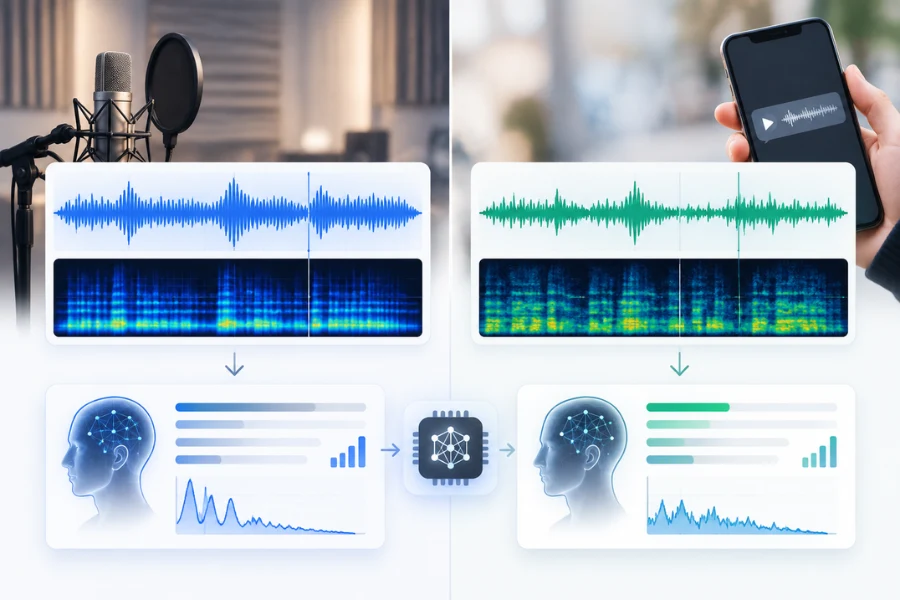
Consider two tests. One evaluates clean WAV files from speech generators represented in the detector's development data. The other evaluates five-second voice messages that have been compressed, forwarded through an app, and generated by previously unseen models.
Both measure AI voice detection, but they test different levels of difficulty.
When evaluating an accuracy claim, check:
Which dataset was used?
Which voice generators were included?
Were any generators unseen during training?
Which languages and speakers were represented?
Was the audio clean, compressed, noisy, or re-recorded?
How long were the samples?
Which detection threshold was used?
Which performance metric was reported?
The evaluation date can also matter because newer synthesis methods may differ from generators represented in older training and test data. A claim such as "99% accurate" therefore describes little without its benchmark conditions.
What Does AI Voice Detection Accuracy Actually Mean?
Accuracy is only one evaluation metric. Precision, recall, false-positive rates, false-negative rates, and EER reveal different aspects of detector performance.
Accuracy
Accuracy measures the proportion of predictions classified correctly on a test set.
If a detector correctly classifies 900 of 1,000 recordings, its accuracy on that test is 90%. The percentage describes that dataset and test setup, not every type of audio the detector may encounter.
Class balance can also make accuracy misleading.
Suppose 95% of a test set contains human speech and only 5% contains AI-generated speech. A classifier that labels every recording as human would achieve 95% accuracy while detecting none of the synthetic clips.
Precision and Recall
Precision measures how often recordings flagged as AI-generated actually are synthetic. Recall measures how many synthetic recordings in the test the detector catches.
Lowering the decision threshold may increase recall by flagging more suspicious audio, but it can also increase false positives. A more conservative threshold may reduce false positives while allowing more synthetic speech to pass as human.
This is why 99% precision, 99% recall, and 99% accuracy do not mean the same thing.
False Positives and False Negatives
A false positive occurs when genuine human speech is classified as AI-generated. A false negative occurs when synthetic speech is classified as human.
The practical cost depends on the use case. Missing a cloned voice can create security risk, while incorrectly flagging a genuine speaker can create reputational or procedural problems.
Equal Error Rate
Equal Error Rate, or EER, is commonly used in speaker verification and speech deepfake detection research. It represents the operating point where false acceptance and false rejection rates are equal.
A lower EER generally indicates better discrimination under the tested conditions. EER is not overall accuracy, so percentages reported using the two metrics should not be compared as though they measure the same outcome.
What Research Tells Us About AI Voice Detector Accuracy
The VoiceWukong benchmark presented at USENIX Security 2025 built its dataset using deepfake speech from 19 commercial tools and 15 open-source tools. Researchers created 38 data variants covering six types of manipulation, producing 265,200 English and 148,200 Chinese deepfake voice samples.
When 12 state-of-the-art detectors were evaluated on VoiceWukong, AASIST2 achieved the lowest EER at 13.50%, while all other evaluated detectors exceeded 20%. These results describe performance on VoiceWukong rather than a universal error rate, but they show that substantial detection errors remained across a broad benchmark.
Audio transformations introduce another source of variation. A study of 10 audio deepfake detection models across 16 common corruption types found that most tested models were relatively robust to noise but more vulnerable to audio modification and compression, especially neural codecs.
Generalization adds a separate challenge. Recent research on speech deepfake detection has identified unseen forgery methods as a major source of failure, with source and generator diversity in training data affecting how well detectors generalize to unfamiliar deepfakes.
These studies test different problems, but together they show why AI voice detector accuracy depends on both the evaluation setup and how closely it resembles the audio being analyzed.
What Makes AI Voice Detectors More or Less Accurate?
Several variables explain why benchmark performance may not transfer directly to a real recording.
The Voice Generator
A detector may learn patterns associated with synthetic speech represented in its training data and perform differently on an unfamiliar synthesis or voice-conversion method.
A newer generator is not automatically undetectable. The relevant question is whether the detector has demonstrated generalization beyond familiar generator families. Evaluations that include generators excluded from detector development provide stronger evidence about this capability.
Audio Compression and Re-encoding
Phone systems, messaging apps, social platforms, and file conversions can alter audio through encoding and compression. These transformations may change acoustic information used for detection.
Research shows that compression and audio modification can reduce detector robustness, although the effect depends on the model and transformation. When possible, analyze the closest available copy to the original recording.
Clip Length
Very short recordings provide less speech for analysis. Longer usable segments may expose more timing, spectral, prosodic, and other acoustic patterns, but there is no universal duration that guarantees accurate detection.
Use a detector's documented minimum or recommended clip length when available rather than assuming one duration applies to every system.
Recording Conditions
Microphones, background noise, room reverberation, telephony bandwidth, and re-recording through a speaker can create a mismatch between deployment audio and the conditions used to evaluate a detector.
Performance demonstrated on clean studio audio should therefore not be assumed to transfer unchanged to a phone call or noisy room recording.
Post-processing
Noise reduction, EQ, pitch processing, mastering, and editing can alter acoustic characteristics after speech is recorded or generated.
The effect depends on which signals the detector uses. Results measured on untouched synthetic speech therefore may not transfer directly to edited podcasts, published videos, or heavily processed voiceovers.
Language and Speaker Differences
Languages, accents, speakers, and speaking styles can differ from those represented in a detector's evaluation data.
Performance measured on one population should not be assumed to transfer equally to another. When language or speaker population matters, look for evaluation data that resembles the audio you need to analyze.
Why a 90% AI Score Does Not Mean 90% Accuracy
A detector displaying a 90% AI score does not necessarily mean there is a 90% probability that the recording is AI-generated.
Three concepts need to remain separate.
Detector accuracy describes system performance across an evaluation dataset.
Detection score is an output produced for an individual recording.
Calibrated probability is a score validated so that its numerical value corresponds meaningfully to observed probabilities.
Not every detector output is calibrated as a probability. A 0.90 score therefore does not automatically mean that nine out of ten recordings receiving that score are synthetic.
Check whether the tool defines its output as a classifier score, confidence score, calibrated probability, or another metric before interpreting the percentage.
False Positives Can Matter as Much as Missed AI Voices
If a genuine recording is classified as synthetic, the result can justify checking the original file, its source, or additional evidence. It does not establish that the speaker used AI or that the recording was fabricated.
This distinction matters more when detection influences employment, fraud investigations, journalism, moderation, or disputes involving a named person.
An AI voice detector evaluates patterns in an audio signal. It cannot independently establish who created the file, why it was created, whether an edit was deceptive, or whether a specific person was responsible.
The acceptable false-positive rate should therefore depend on the consequences of a wrong classification rather than headline accuracy alone.
When Should You Trust an AI Voice Detection Result?
The conditions around a recording help determine how much weight to place on a detection result.
| Situation | How to Interpret the Result |
|---|---|
| Original, clear audio | Usually more informative than a degraded copy |
| Longer continuous speech | May provide more usable evidence |
| Generator included in relevant evaluation data | Published benchmark results may be more relevant |
| Very short voice note | Interpret with more caution |
| Phone or messaging audio | Consider channel and compression effects |
| Re-recorded audio | Interpret with more caution |
| Heavily processed audio | Processing may affect detection signals |
| New or unknown generator | Generalization is less certain |
| Multiple independent signals agree | Provides stronger supporting evidence |
| Detectors strongly disagree | Treat the origin as unresolved |
These conditions do not assign fixed reliability levels. They indicate how closely an individual recording resembles conditions for which the detector has relevant evidence.
How to Evaluate an AI Voice Detector Accuracy Claim
Before comparing headline percentages, check what was actually measured.
Check the dataset
An internal test set and a diverse external benchmark provide different evidence about detector performance.
Check the voice generators
Performance against one generator family does not establish equal performance against others.
Look for unseen generators
Testing on generators excluded from detector development provides stronger evidence about generalization.
Check the audio conditions
Clean WAV files, compressed voice notes, phone recordings, and re-recorded audio represent different detection conditions.
Identify the metric
Accuracy, precision, recall, EER, and confidence scores answer different questions.
Look for the false-positive rate
A detector that catches synthetic speech but frequently flags genuine speakers may be unsuitable where false accusations carry significant costs.
Without these details, an accuracy percentage cannot be reliably mapped to your own recording.
How to Check a Suspicious Voice More Reliably
Use detection as one signal within a broader verification process.
Start with the best available audio
Prefer the original file over a screen recording, forwarded copy, or repeated export.Analyze more usable speech
If a longer version of a short clip exists, analyze it as well. More speech can provide additional evidence, although duration alone does not guarantee accuracy.Understand the score
Determine whether the output is a classifier score, confidence value, calibrated probability, or another metric.Look for independent evidence
Check provenance information, an embedded watermark, the original source, another recording from the same event, or an independent detector. Agreement is more informative when the signals do not depend on the same underlying evidence.Verify identity separately when the stakes are high
For suspected impersonation or voice-cloning fraud, contact the person through a phone number or account you already trust. Identity verification can answer a question that audio classification alone cannot.
Detection Is Not the Same as Provenance
AI voice detection infers whether audio characteristics resemble genuine or synthetic speech. Provenance systems and watermarks instead provide information intentionally attached to or embedded in content during generation.
A valid watermark from a known generation system can provide direct evidence about origin that pattern-based classification cannot. Its absence, however, does not prove human origin because not every generator uses the same provenance system.
Detection is therefore useful when provenance information is unavailable, but the two signals answer different questions and should not be treated as interchangeable.
Where the Unfox AI Voice Detector Fits
The Unfox AI Voice Detector can provide an additional signal when examining whether a recording shows characteristics associated with AI-generated speech.
Interpret its result alongside the recording's quality and length, how the audio reached you, whether it has been processed, and whether independent evidence supports the same conclusion.
For consequential decisions, use detection alongside additional verification rather than treating one score as proof of origin.
Final Thoughts
AI voice detector accuracy depends on the detector, evaluation dataset, voice generator, audio conditions, and metric being measured. Research shows that speech deepfake detection can identify synthetic audio while still facing meaningful errors from audio corruption and unfamiliar generation methods.
Benchmark results are useful for comparing systems under stated conditions, not for guaranteeing the classification of an individual recording. For a specific result, ask how closely the recording, generator, and audio conditions match what the detector has actually been evaluated to handle.
A detection score is best treated as one piece of evidence within a broader verification process.
FAQ
Are AI voice detectors accurate?
AI voice detectors can identify synthetic speech under some conditions, but there is no universal accuracy rate. Performance varies with the detector, generator, dataset, audio quality, clip length, language, compression, and other testing conditions.
Can AI voice detectors detect cloned voices?
Some detectors are designed to identify synthetic or cloned speech. Performance depends on factors such as the cloning method, detector training data, audio conditions, and generalization to unfamiliar generators.
Can AI voice detectors give false positives?
Yes. A false positive occurs when genuine human speech is classified as AI-generated. The risk matters especially when a detection result could affect decisions about a real person.
Does audio quality affect AI voice detection?
It can. Compression, recording channels, re-encoding, audio modification, and other transformations can change information used by a detector. The effect varies by detection model and transformation.
Can AI voice detectors analyze phone calls and voice messages?
Some tools can analyze these recordings, but phone codecs, messaging compression, short duration, and other channel effects can make them different from clean benchmark audio. A successful analysis does not establish that benchmark performance applies unchanged.
What does a 90% AI detection score mean?
It depends on how the detector defines its output. A 90% score does not automatically mean there is a 90% probability the recording is AI-generated or that the detector itself is 90% accurate.
Can an AI voice detector prove that a recording is fake?
A detector can provide evidence that audio resembles synthetic speech, but its result alone generally cannot establish provenance, attribution, intent, or who created the recording. Higher-stakes conclusions require additional evidence.