
ChatGPT tokens work by breaking text into small units that the model converts into numerical representations and uses to predict the next token one step at a time.
A token can be a whole word, part of a word, punctuation, or another piece of text. Each generated token then joins the existing context and influences the tokens that can follow it.
The basic process looks like this
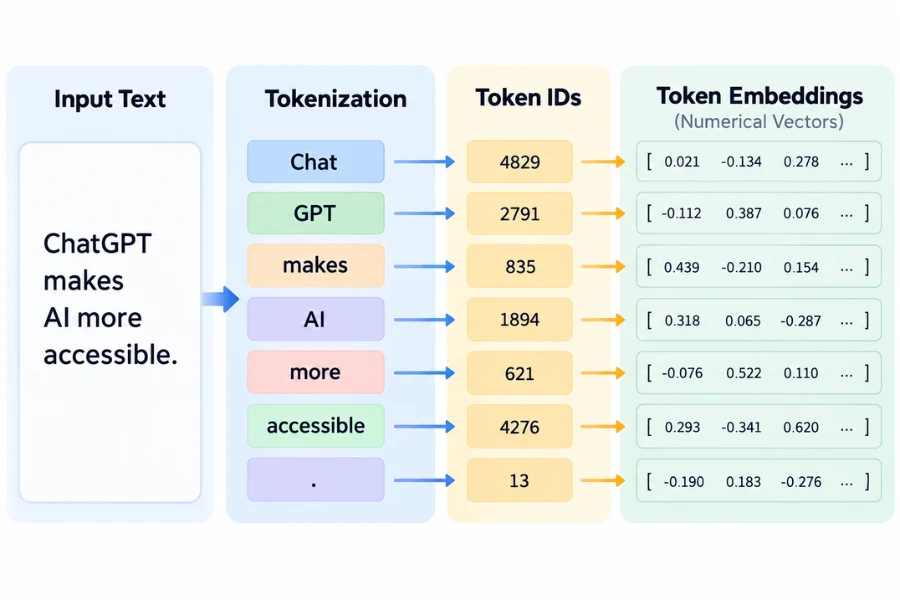
Text → Tokens → Token IDs → Embeddings → Model Processing → Next Token → Repeat
Tokens therefore affect more than text length. Their number and type influence how much context a model can process, how much output it can generate, and how API usage is measured.
What Is a ChatGPT Token?
A token is a unit of text processed by a language model rather than a fixed unit such as a word.
Depending on the tokenizer, one token may represent
- A complete word
- Part of a word
- Punctuation
- A number
- A symbol
- Part of a Unicode character
A common word may fit into one token, while an uncommon or longer word may be divided into several subword tokens. This allows a tokenizer to represent unfamiliar words by combining smaller units already present in its vocabulary.
For typical English text, OpenAI gives a rough estimate of about four characters or three-quarters of a word per token. Under that approximation, 100 tokens correspond to roughly 75 words.
The ratio is not fixed. Language, spelling, capitalization, whitespace, formatting, and the encoding used by a model can change the actual token count.
How Does ChatGPT Turn Text Into Tokens?
Before text reaches the language model, a tokenizer divides it according to its vocabulary and tokenization rules.
The Tokenizer Splits Your Text
Suppose you enter
Write an email
A tokenizer may recognize each word as an individual token, while a less common word may be divided into several subword tokens.
Token boundaries depend on the tokenization method, vocabulary, encoding, and data used to develop the tokenizer. Identical text can therefore produce different token counts under different encodings or models.
Tokens Become Token IDs
After tokenization, each token maps to an integer called a token ID.
A simplified example looks like this
Text
Write an email
Tokens
Write → an → email
Token IDs
14350 → 385 → 4876
These IDs are illustrative. The actual numbers depend on the encoding.
The model receives the sequence of token IDs. Each ID acts as an index for looking up an embedding, which is the numerical vector the neural network processes.
Why Does ChatGPT Use Tokens Instead of Words?
A word-level system would need a very large vocabulary to represent different word forms, names, technical terms, uncommon spellings, and new expressions. Words absent from that vocabulary would also require a fallback representation.
Character-level tokenization avoids the unknown-word problem but creates longer sequences. The word playing, for example, requires seven character units if every character is processed separately.
Subword tokenization balances these two approaches. Frequent words or patterns can use compact representations, while unfamiliar words can be assembled from smaller known pieces.
The trade-off is between vocabulary size and sequence length. Larger reusable text units shorten many sequences, while smaller units make the tokenizer more flexible when it encounters unfamiliar text.
How ChatGPT Uses Tokens to Generate a Response
After tokenization, the model processes the resulting sequence and predicts what token should come next. It does not normally generate an entire paragraph in one operation.
Token IDs Are Mapped to Embeddings
A token ID is an index rather than a meaningful numerical representation by itself.
The model uses that ID to retrieve an embedding vector associated with the token. Transformer layers then process these vectors in the context of the surrounding sequence to produce the representation used for next-token prediction.
The Model Predicts the Next Token
Consider a prompt ending with
The capital of France is
The model processes the existing sequence and produces scores for possible next tokens. In this context, a token representing Paris would normally receive a stronger score than many unrelated alternatives.
After one token is selected, it becomes part of the sequence
Prompt → predict token 1
Prompt + token 1 → predict token 2
Prompt + token 1 + token 2 → predict token 3
This autoregressive loop continues until the response is complete or a generation limit is reached.
ChatGPT Chooses From Possible Next Tokens
The model produces scores across possible next tokens rather than retrieving one predetermined continuation for each prompt. A decoding strategy converts those scores into the token selected for the next generation step.
Sampling settings can alter how readily lower-probability alternatives are selected. Identical prompts can therefore produce different token sequences even when the underlying model is unchanged.
What Types of Tokens Does ChatGPT Use?
OpenAI API usage can distinguish several token categories.
| Token type | What it means |
|---|---|
| Input tokens | Tokens supplied to the model in a request |
| Output tokens | Tokens generated by the model |
| Cached input tokens | Input associated with a reusable prompt prefix whose prior processing can be reused through prompt caching |
| Reasoning tokens | Internal tokens used by reasoning models before producing the visible answer |
Prompt caching does not simply store text tokens and resend them. In supported API workflows, matching prompt prefixes can reuse intermediate processing from an earlier request, reducing repeated computation.
Reasoning tokens create a different distinction. They are not displayed as answer text, but OpenAI counts them toward output usage for models that use them.
Actual API usage can therefore differ from a count of the visible prompt and answer. Message structure, tools, schemas, images, files, and other supported inputs can contribute to the request's token usage.
Why Can the Same Text Use Different Numbers of Tokens?
Token count depends on the tokenizer and the structure of the input rather than word count alone.
Tokenizer and encoding
Different vocabularies and encodings can split identical text differently.
Language
The same meaning can require different numbers of tokens across languages because a tokenizer's vocabulary does not represent every language with equal efficiency.
Common and rare words
Frequently represented patterns may fit into fewer tokens. Unusual names, spellings, or technical terms may be divided into smaller pieces.
Capitalization and surrounding text
Capitalization and leading spaces can change how otherwise similar strings match entries in a tokenizer's vocabulary.
Code, symbols, and emoji
Programming syntax, indentation, operators, and Unicode characters can produce token patterns that differ from ordinary English prose.
For an exact model-specific count, word count is therefore insufficient. The text must be processed with the relevant tokenizer or measured through the API request itself.
How Tokens Affect ChatGPT Context and Responses
A model's context window defines how much tokenized information it can work with within its supported context capacity.
That context can include system or developer instructions, user input, relevant conversation history, tool-related information, and other content supplied to the model. The exact composition depends on the product and request.
The context window is different from the maximum output limit. A model can support a large input context while imposing a smaller limit on how many tokens it can generate in one response.
There is no single universal ChatGPT token limit. Context windows and maximum output limits vary by model and product configuration, so current model documentation is more reliable than a fixed number taken from an older article.
For long-document tasks, repeated or irrelevant material consumes context capacity that could otherwise hold instructions, source material, conversation history, or generated output needed for the task.
How Tokens Affect API Cost and Speed
OpenAI API pricing can distinguish between input, cached input, and output usage, with rates varying by model and processing configuration. A short visible answer does not by itself reveal the total token usage or cost of a request.
Inference also treats input and generated output differently. During prefill, the model processes the supplied input sequence. During decode, it generates output sequentially, with each new token depending on the preceding context.
Longer inputs increase the amount of context that must be processed during prefill, while longer responses require more decoding steps. Actual latency also depends on the model, infrastructure, request configuration, and whether supported caching mechanisms can reuse prior processing.
How to Count ChatGPT Tokens
Word count is useful for estimating document length but cannot determine an exact model-specific token count.
For rough planning, typical English word-to-token estimates may be sufficient. When the exact split matters, the text needs to be processed using the relevant tokenizer.
Complete API requests require additional care because message formatting, tools, schemas, images, files, and conversation structure can contribute to usage beyond plain text. Reported API usage is therefore more authoritative for a completed request than manually converting its visible words into tokens.
For a quick pre-request estimate, the Unfox AI Token Calculator can help you check the approximate token size of a prompt, article, or document without manually converting words or characters.
How to Use Tokens More Efficiently
Reduce token usage where text adds processing cost or consumes context without adding useful information.
Remove duplicated instructions and repeated source material. Summarize sections when their full detail is unnecessary, and divide oversized documents when the task can be completed in independent stages.
For API workflows with repeated prompt prefixes, supported caching can reduce repeated processing. Output limits can also constrain unnecessary generation when the required response length is predictable.
Do not remove context solely to minimize token count. Information required to interpret the task, apply constraints, or support the answer has more value than the tokens saved by deleting it.
FAQ
How many words is 1,000 ChatGPT tokens?
For typical English text, OpenAI's rough estimate corresponds to about 750 words per 1,000 tokens. The actual count varies with language, formatting, vocabulary, and encoding.
How much text is 1 million tokens?
Applying the same rough English estimate gives about 750,000 words for one million tokens. This describes scale rather than an exact conversion.
Does ChatGPT count words or tokens?
Language models process tokens rather than conventional word counts. A word may correspond to one or several tokens depending on the tokenizer and surrounding text.
Do spaces and punctuation count as tokens?
Spaces and punctuation affect tokenization, but each one does not necessarily become a separate token. Their representation depends on the encoding and surrounding text.
Why do different models count tokens differently?
Different encodings, vocabularies, and tokenizer designs can divide identical text into different token sequences.
Do ChatGPT responses use tokens?
Yes. Visible responses consist of output tokens. Reasoning models can also use internal reasoning tokens that do not appear in the displayed answer.
Conclusion
ChatGPT processes text by converting it into tokens, mapping those tokens to IDs and embeddings, and using the resulting context to predict one new token at a time.
This mechanism explains why token counts vary across text and models, why context and output limits are measured in tokens, and why API usage can exceed what a simple word count suggests.
For long prompts or documents, estimating token usage before a request can help you judge whether the input fits the intended model and how much context it will consume.