
AI detectors can identify AI-generated text with useful accuracy under some conditions, but there is no universal accuracy rate. Performance depends on the detector, test dataset, AI model, text type, language, editing, and classification threshold.
An AI detection score therefore describes a model's classification of the submitted text, not verified authorship. How much weight the result deserves depends on both the testing conditions and the consequences of getting the classification wrong.
How Accurate Are AI Detectors?
AI detector accuracy varies too much to reduce the entire category to a number such as 90% or 99%.
A 2026 study tested Turnitin and Originality.ai on 192 texts, including authentic student writing, professional human writing, AI-generated text, and hybrid content. Overall accuracy under those test conditions was 61% for Turnitin and 69% for Originality.ai. Both systems had particular difficulty with hybrid writing.[1]
Another 2026 study tested GPTZero, Pangram, Copyleaks, and Turnitin across 160 academic documents. Performance differed substantially by detector and content type. Fully human-written documents were identified correctly in that dataset, while several tools underestimated AI involvement in AI-generated, hybrid, or humanized text.[2]
These results should not be combined into an "average AI detector accuracy." The studies used different datasets, detectors, AI models, text categories, and experimental designs.
A published accuracy rate describes performance under defined test conditions. It is not a permanent accuracy rating for the detector across new models, languages, genres, or edited text.
Accuracy Is Not the Same as Reliability
Accuracy measures the proportion of correct classifications across a test set. It does not tell you how trustworthy an individual AI flag is.
| Metric | What It Tells You |
|---|---|
| Accuracy | How often all classifications are correct |
| Precision | Among text classified as AI, how much is actually AI |
| Recall | Among actual AI text, how much the detector identifies |
| False positive rate | How often human writing is incorrectly classified as AI |
| False negative rate | How often AI-generated writing is incorrectly classified as human |
Classification thresholds create practical trade-offs. Lowering a threshold to increase recall can catch more AI-generated text, but it may also increase false positives. Raising the threshold can reduce some false alarms while increasing missed AI content.
Two detectors can therefore report similar overall accuracy while producing very different numbers of false accusations or missed detections.
Why the Base Rate Matters
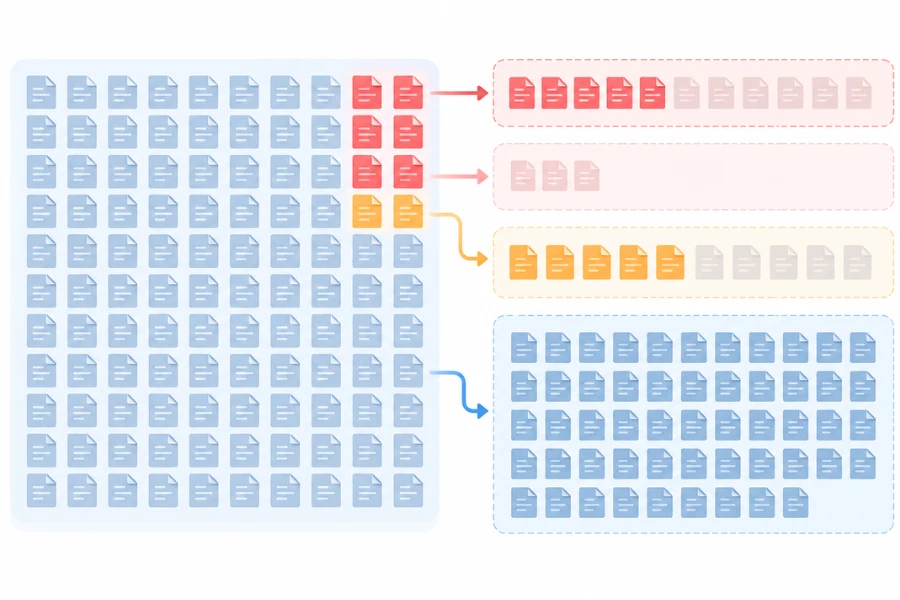
Consider a hypothetical review of 1,000 documents where only 5% are actually AI-generated.
If a detector catches 90% of those 50 AI documents, it produces 45 true positives. With a 5% false positive rate, about 48 of the remaining 950 human documents would also be flagged.
The reviewer would receive about 93 flags, yet only 45 would represent the AI-generated documents in this simplified example.
These are hypothetical numbers, not the measured performance of a specific detector. They show why a strong recall rate and a low-looking false positive rate can still produce many incorrect flags when the condition being detected is relatively uncommon.
What Does an AI Detection Score Actually Mean?
A result such as 40% AI does not necessarily mean there is a 40% probability that the author used AI.
Detector scores can represent different measurements, including the proportion of classified text, document-level confidence, aggregated sentence classifications, or a proprietary score. The interpretation depends on the tool.
Turnitin provides a useful example. Its AI Writing Report percentage represents the amount of qualifying prose its model identifies as likely AI-generated or as AI-generated text subsequently modified with certain AI text-altering tools. It does not represent the probability that a student used AI.[3]
Turnitin also displays *% instead of an exact percentage for results from 1% through 19% because its testing found a higher incidence of false positives in that range.[3]
That scoring definition is specific to Turnitin. Before interpreting any percentage, check what the detector actually claims to measure.
What Makes AI Detection More or Less Reliable?
No single variable determines detection reliability.
| Condition | Likely Effect | Why |
|---|---|---|
| Adequate text length | Can provide more signal | More linguistic patterns are available for analysis |
| Raw AI output | Often easier to identify | Generation patterns remain relatively intact |
| Human-edited AI text | More difficult | Editing can alter classification features |
| Hybrid human-AI text | More difficult | Different writing processes appear in one document |
| Very short text | Often less stable | Less linguistic evidence is available |
| New AI models | Tool-dependent | Detector training may not represent newer generators |
| Non-native writing | Requires caution | Linguistic style can interact with learned patterns |
| Formulaic technical writing | Requires caution | Restricted vocabulary and structure may increase predictability |
| Non-English text | Tool-dependent | Language coverage and training data vary |
Adequate text length can provide more evidence, but longer documents are not automatically easier to classify. Genre, document structure, detector design, and where AI-written passages appear within a document can also affect performance.
Turnitin, for example, currently requires at least 300 words of qualifying prose for an AI Writing Report and warns that shorter submissions may produce less accurate results. This is a Turnitin requirement, not a universal threshold for AI detection.[3]
Why False Positives Happen
A false positive occurs when human-written text is classified as AI-generated. Detectors infer authorship-related categories from features in the finished text, so human prose can sometimes resemble patterns represented in the AI class.
Predictability helps explain part of this problem. Perplexity describes how predictable text appears to a language model, while sentence-level variation is sometimes discussed through concepts such as burstiness. Modern detectors may also rely on learned classifiers and undisclosed proprietary features.[4]
Technical terminology, standardized academic structures, or other constrained writing patterns can make human prose relatively predictable without making it AI-generated.
Preprocessing can add another variable. Research reviewed in 2026 found that minor preprocessing differences, including whitespace handling, substantially changed detector performance on a particular dataset. The result does not generalize to every detector, but it demonstrates that classification can respond to document artifacts unrelated to authorship.[4]
The practical risk therefore varies with the detector, dataset, language, and writing style rather than being identical for every human-written document.
Why AI-Generated Text Can Go Undetected
A false negative occurs when AI-generated writing is classified as human. Editing and paraphrasing can alter the features used to distinguish generated text.
Sadasivan and colleagues stress-tested several families of AI text detection methods with recursive paraphrasing and found that detection performance could be reduced substantially while much of the text quality was maintained.[5]
The experiment does not show that paraphrasing always makes AI writing undetectable. It shows that accuracy measured on raw model output cannot automatically be generalized to edited AI text.
Hybrid Writing Creates a Harder Problem
A document may combine a human-written draft, AI-assisted revisions, manually rewritten suggestions, and AI grammar editing. The final text no longer belongs cleanly to one binary authorship category.
The 2026 evaluation of Turnitin and Originality.ai found hybrid texts particularly difficult compared with cleaner human and AI categories.[1]
For mixed workflows, the useful question may therefore shift from "Was this written by AI?" to "What evidence indicates how AI contributed to the final text?"
Why Do Different AI Detectors Give Different Results?
Detectors can disagree because they use different training data, model architectures, classification thresholds, preprocessing methods, language coverage, supported AI generators, and update schedules. Commercial systems may also keep important classification features proprietary.
Research comparing multiple commercial detectors has documented substantial disagreement on the same known-provenance writing.[4] A high score from one detector and a human classification from another can therefore reflect model differences rather than a change in the underlying document.
Cross-tool agreement can justify closer examination, but agreement does not independently verify authorship. Large disagreement is a reason to reduce confidence in any single score and examine other evidence.
How Much Should You Trust an AI Detector Result?
The appropriate level of confidence depends on both detection conditions and the cost of a wrong decision.
| Situation | How to Treat the Result |
|---|---|
| Sufficient supported text with a strong, consistent result | Useful screening evidence |
| Borderline or low-confidence result | Treat as uncertain |
| Very short or highly formulaic text | Use additional caution |
| Edited or hybrid human-AI content | Expect greater uncertainty |
| Major disagreement between detectors | Investigate other evidence |
| High-stakes academic or professional decision | Require independent evidence |
The same detector result can justify different actions depending on the stakes. An editorial team may use a flag to prioritize manual review, while an academic misconduct decision requires stronger evidence because a false positive has greater consequences.
The higher the cost of a wrong classification, the less appropriate it is to rely on the detector score alone.
How to Interpret AI Detection Results Responsibly
A useful review separates what the detector knows about the final text from evidence about how that text was produced.
1. Check What the Score Means
Read the detector's scoring documentation. Determine whether the result represents classified text, confidence, probability, or another metric before interpreting the number.
2. Check the Sample
Consider text length, language, genre, quotations, templates, technical terminology, and whether AI tools were used during editing. These conditions can change how much confidence a detector result deserves.
3. Review the Flagged Passages
If passage-level results are available, inspect them rather than relying only on the document score. Determine whether the flagged language could reflect standardized, technical, or otherwise constrained writing.
4. Look for Process Evidence
Drafts, notes, revision history, source material, and explanations of the writing process provide evidence a text classifier cannot obtain from the final document.
AI detectors analyze the finished product. Authorship decisions often require evidence about the process.
5. Match the Evidence to the Consequence
A detector may be sufficient for deciding what content deserves manual review. Academic discipline, employment decisions, or other high-stakes actions require stronger corroborating evidence and human judgment.
For users reviewing their own content, the Unfox AI Detector can provide an additional classification signal. Its result is more useful when interpreted alongside the text, writing conditions, and available process evidence.
FAQ
Do AI Detectors Really Detect AI?
AI detectors classify linguistic patterns associated with human and AI-generated text. They do not directly observe the writing process, so a detection result is not the same as verified authorship.
Is 40% AI Detection Bad?
There is no universal interpretation of a 40% AI score. Its meaning depends on how the detector calculates the percentage, while text type, length, editing history, and highlighted passages affect how much weight the result deserves.
Can AI Detectors Be 100% Accurate?
No current detector should be assumed to classify every text correctly. Performance can change across AI models, datasets, languages, genres, and edited or hybrid content.
Why Do Different AI Detectors Give Different Results?
Different detectors use different training data, thresholds, models, preprocessing methods, and language or generator coverage. The same text can therefore produce different classifications.
Can Human-Written Text Be Detected as AI?
Yes. A false positive occurs when human-written text is classified as AI-generated. The risk varies with the detector and characteristics of the text.
The Bottom Line
There is no universal percentage that defines AI detector accuracy. A result is meaningful only in relation to the detector, evaluation conditions, text characteristics, and scoring method.
Use AI detection to identify content that may require further review. When the consequences of an incorrect classification are significant, combine text-level detection with human review and evidence about the writing process.
References
[1] Hadra et al. — 2026 evaluation of Turnitin and Originality.ai across human, AI-generated, and hybrid writing. International Journal of Educational Technology in Higher Education.
[2] 2026 comparative study of GPTZero, Pangram, Copyleaks, and Turnitin across 160 academic documents. International Journal of Educational Technology in Higher Education.
[3] Turnitin — Using the AI Writing Report. Official documentation covering AI percentage interpretation, low-score reporting, and qualifying-text requirements.
[4] 2026 review of AI text detection reliability, bias, preprocessing effects, and cross-detector disagreement. AI and Ethics.
[5] Sadasivan et al. — Can AI-Generated Text Be Reliably Detected? Research on the robustness and limitations of AI-generated text detection.