
To calculate AI tokens, you can either estimate them from text length or count them with the tokenizer used by your target model.
For English text, a common rough estimate is about 1 token per 4 characters, or roughly 100 tokens per 75 words. These are planning shortcuts, not exact conversion formulas.
If you need a model-specific count, use the tokenizer associated with that model. For quick text checks without setting up code, an AI token counter can provide a more convenient option.
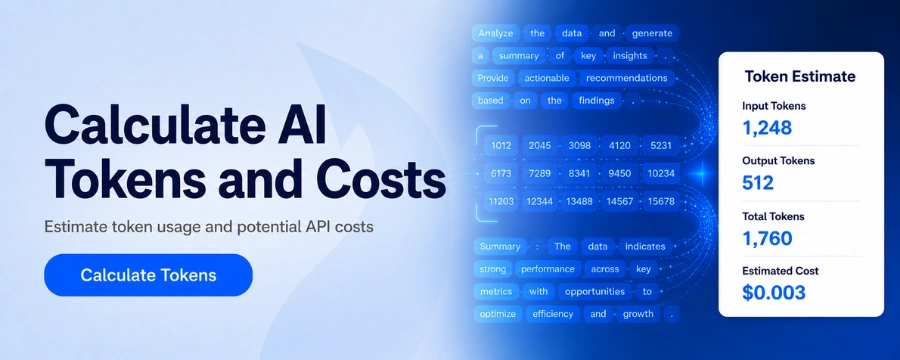
How to Calculate AI Tokens Quickly
The calculation method depends on what you need the number for.
| If You Need | Best Approach |
|---|---|
| A quick estimate | Word or character estimate |
| An exact token count | Model-specific tokenizer |
| Token usage after an API request | API usage metadata |
| An API cost estimate | Token count × current token rate |
For ordinary English text, these rules can help with quick planning.
About 4 characters ≈ 1 token
About 75 words ≈ 100 tokens
About 750 words ≈ 1,000 tokens
About 1,500 words ≈ 2,000 tokens
Actual counts can differ. Treat these numbers as estimates rather than fixed ratios.
For example, if you have 1,200 English words, a rough calculation would be
1,200 ÷ 0.75 ≈ 1,600 tokens
That may be enough when estimating document size. If you need to check a context limit or calculate API usage more precisely, use the appropriate tokenizer instead.
Why Word Count Does Not Equal Token Count
A token is not necessarily a word.
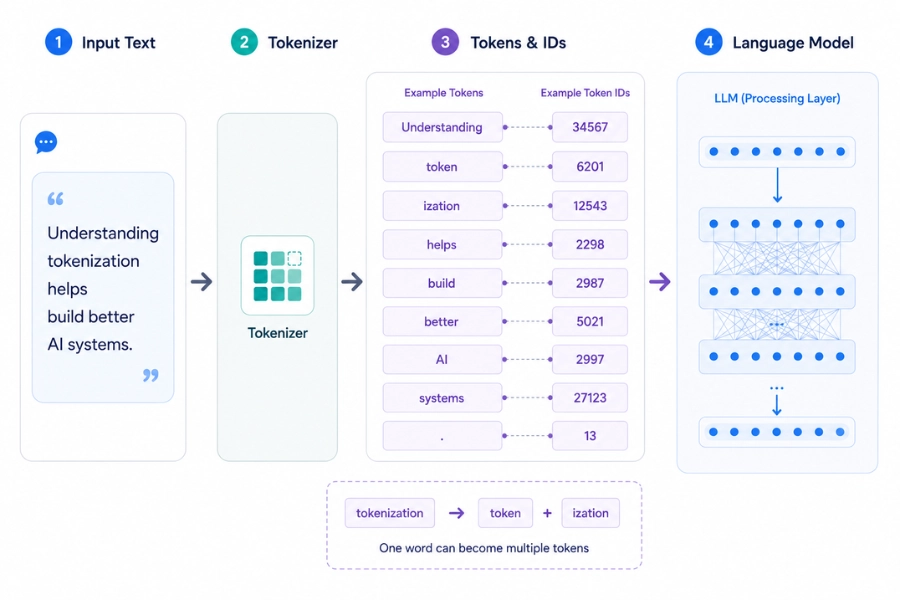
Before an LLM processes your prompt, a tokenizer breaks the text into smaller units and maps those units to token IDs.
The process can be simplified as
Text → Tokenizer → Tokens → Token IDs → Model
Modern LLMs often use subword tokenization. A common word may correspond to one token, while a longer or less familiar word may be divided into several pieces.
This helps explain why two passages with the same word count can have different token counts.
What Determines the Number of Tokens
Tokenization depends on several factors.
Tokenization method — Model families can use approaches such as BPE or WordPiece
Tokenizer design — Vocabulary size and special tokens affect how text is divided
Training data — Tokenizers developed from different languages, code, and other datasets can build different vocabularies
There is no universal conversion that gives an exact token count for every AI model.
How to Get an Exact AI Token Count
When precision matters, count the text with the tokenizer associated with your target model.
Use an Online AI Token Counter
For most users, an online tool is the simplest way to check text without writing code.
Paste your text into the tool, select the relevant model or encoding when supported, and review the resulting token count.
If you want a quick way to inspect text, Unfox AI Token Calculator can simplify the process without requiring a programming environment.
Check which models or tokenization methods a calculator supports before treating its result as model-specific. A count produced for one tokenizer should not automatically be treated as exact for another model.
Use a Tokenizer Library
Developers can calculate tokens programmatically.
For supported OpenAI models, for example, the relevant tokenizer library can encode a string into token IDs. Counting those IDs gives you the number of tokens produced by that encoding.
tokens = encoding.encode(text)
token_count = len(tokens)
This approach is useful when an application needs to check prompt size automatically before sending an API request.
Check API Usage After the Request
If you have already made an API request, check the usage information returned by the provider when available.
This is preferable to estimating completed usage because the API can report what the request actually consumed.
Before a request → estimate or tokenize
After a request → check reported usage
Why AI Token Counts Differ Between Models and Text
Text length is only one factor affecting token count.
Language, capitalization, punctuation, emoji, code, and tokenizer design can all change how a sequence is divided.
Language
English-based rules of thumb should not be applied universally.
Chinese, Japanese, Korean, Arabic, and other languages can have different relationships between characters, words, and tokens. Multilingual applications should test representative text with the tokenizer they actually use.
Spaces, Capitalization, and Punctuation
These visually similar examples do not necessarily receive identical token representations.
redRedred
Depending on the tokenizer, capitalization, position, and surrounding spaces can affect tokenization.
Punctuation can also become an individual token or part of another token.
Emoji and Special Characters
One visible emoji does not necessarily equal one token.
Emoji and other Unicode characters can have underlying representations that make visual character counting unreliable.
This is particularly relevant for social media, messaging, and multilingual content.
Code
Code contains indentation, operators, variable names, keywords, and punctuation that ordinary prose does not.
A Python program may therefore tokenize differently from an English paragraph of similar visible length. If your application processes code, test real code samples instead of relying on English word estimates.
How to Calculate Input and Output Tokens
For API usage, the text in your prompt is only part of the calculation.
At a basic level
Total token usage = Input tokens + Output tokens
If a request uses 800 input tokens and generates 300 output tokens, the basic total is
800 + 300 = 1,100 tokens
Actual requests can be more complex. Depending on the model and API, input may include system instructions, conversation history, retrieved documents, or other context.
Some providers also distinguish cached tokens, reasoning tokens, or other usage categories. Check the provider's current documentation when those categories affect usage or billing.
How to Calculate AI Token Cost
Token count becomes particularly useful when estimating API spending.
When a provider quotes pricing per one million tokens, calculate input cost as
Input cost = Input tokens ÷ 1,000,000 × Input price per million
Then calculate output separately.
Output cost = Output tokens ÷ 1,000,000 × Output price per million
Finally
Estimated cost = Input cost + Output cost
Suppose a hypothetical model costs $2 per million input tokens and $8 per million output tokens.
For 100,000 input tokens
100,000 ÷ 1,000,000 × $2 = $0.20
For 20,000 output tokens
20,000 ÷ 1,000,000 × $8 = $0.16
The estimated total would be $0.36.
These prices are illustrative. Use the provider's current pricing when calculating real API costs.
How Many AI Tokens Can $1 Buy
There is no universal answer because token prices differ by model and usage category.
For example, if a hypothetical model charges $5 per million input tokens
$1 ÷ $5 × 1,000,000 = 200,000 input tokens
If its output price is $15 per million tokens, $1 would instead buy about 66,667 output tokens.
This is why comparing models only by their headline price per million tokens can be misleading. Input and output usage patterns also matter.
How Token Counts Affect Context Limits
A model's context window determines how much information it can process within the applicable context.
Prompts, system instructions, conversation history, documents, and other context can all consume tokens.
If your content approaches the model's limit, you may need to shorten repeated instructions, retrieve only relevant document sections, summarize older context, or split a large task into smaller parts.
Token usage can also affect cost and latency. The actual impact depends on the model, workload, and infrastructure.
How to Reduce AI Token Usage
Reducing token usage does not mean making every prompt as short as possible. Removing useful context can hurt output quality and sometimes lead to additional requests.
Instead, focus on unnecessary tokens.
Remove duplicated instructions
Avoid repeatedly sending irrelevant context
Retrieve only relevant parts of large documents
Summarize older conversation history when appropriate
Specify an output length when you do not need a long response
Measure token usage before optimizing small details
Clear instructions can also help control output length. Asking for "three concise bullet points," for example, gives the model a clearer output constraint than simply requesting a detailed explanation.
AI Token Calculator vs Manual Estimation
Manual estimation works well when you only need a rough planning number.
A model-specific tokenizer is better when precise preprocessing matters, while API usage metadata is more useful after a request has already been completed.
An AI token calculator provides a more accessible option when you want to check text without writing code. Unfox AI can be useful for quickly checking token usage while working with prompts, documents, or other AI content.
Final Thoughts
There is no single word-to-token formula that works exactly across every AI model.
Use word or character estimates when an approximate number is enough. Use the tokenizer associated with your target model when you need a model-specific count. For API budgeting, calculate input and output usage separately and apply the relevant current pricing.
If you regularly work with prompts, documents, or API costs, Unfox AI can provide a simpler way to check token usage without calculating everything manually.
The practical rule is straightforward — estimate when an approximate number is enough, tokenize when precision matters, and use reported API usage when the request is already complete.
FAQ
How Is an AI Token Calculated
AI tokens are produced by a tokenizer. It divides text according to its vocabulary and tokenization rules, then maps the resulting units to token IDs.
Counting those IDs gives the token count for that tokenizer.
How Many Words Are 1,000 AI Tokens
A common English estimate puts 1,000 tokens at roughly 750 words.
This is only a rule of thumb. The actual number depends on the tokenizer and the content being processed.
How Many Tokens Are 1,000 Characters
Using the rough English estimate of four characters per token, 1,000 characters would be around 250 tokens.
Code, emoji, non-English text, and unusual vocabulary can produce different results.
How Much Does 1 Million AI Tokens Cost
There is no fixed price.
The cost depends on the provider, model, and token category. Input and output tokens often have different rates, so check the current pricing for the specific model you use.
Do ChatGPT, Claude, and Gemini Count Tokens the Same Way
Not necessarily. Different model families can use different tokenizers, vocabularies, and tokenization methods.
The same text can therefore produce different token counts across models.
Can I Calculate Tokens Before Sending an API Request
Yes. You can use a rough word or character estimate for planning, or a model-specific tokenizer when you need a more precise count.
For applications that process many prompts or documents, token counting can also be built into the workflow before requests are sent.