
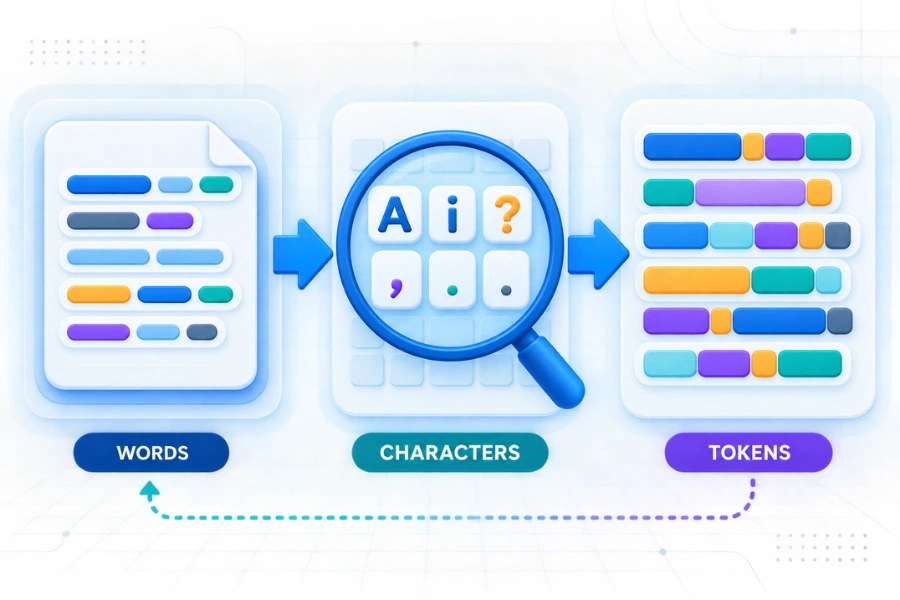
Words, characters, and tokens measure text in different ways. Writers usually track words, online platforms often set character limits, and AI models process tokens.
There is no fixed conversion rate between them. For common English text, one token generally corresponds to about four characters or 0.75 words, according to the OpenAI Tokenizer.
These ratios are useful for planning, but the actual result depends on the tokenizer, language, vocabulary, and formatting. When model limits or API costs matter, check your text with a compatible tokenizer or the Unfox AI Token Calculator.
Words, Characters, and Tokens Explained
| Unit | What it measures | Common use |
|---|---|---|
| Word | A recognizable unit of written language | Articles, essays, and writing limits |
| Character | A letter, number, space, punctuation mark, or symbol | Forms, metadata, and social posts |
| Token | A text unit processed by an AI model | Prompts, context limits, and API usage |
A token is not necessarily a complete word. It may represent a word, part of a word, punctuation mark, or common character sequence.
Common words may fit into one token. Long, uncommon, or technical words may split into several tokens.
Quick Conversion Estimates
The following estimates work best for ordinary English prose.
| Conversion | Rough estimate |
|---|---|
| Words to characters with spaces | Words × 5 to 6 |
| Words to characters without spaces | Words × 4 to 5 |
| Characters to words | Characters ÷ 5 to 6 |
| Words to tokens | Words × 1.33 |
| Tokens to words | Tokens × 0.75 |
| Characters to tokens | Characters ÷ 4 |
| Tokens to characters | Tokens × 4 |
These formulas provide approximate ranges. Other languages, code, URLs, numbers, and special characters may produce different results.
How to Convert Words and Characters
For a broad estimate of regular English prose, one word takes around five to six characters when spaces are included.
Estimated characters with spaces
Words × 5 to 6
A 500-word article may contain roughly 2,500 to 3,000 characters including spaces. Writing with longer words may exceed this range.
To estimate words from characters, reverse the formula.
Estimated words
Characters ÷ 5 to 6
A passage with 3,000 characters may contain approximately 500 to 600 words. This calculation cannot provide an exact word count because average word length varies.
Do Spaces Count as Characters?
Most character counters include spaces unless they display a separate count without spaces.
Consider this sentence.
AI tools turn text into tokens.
It contains:
- 6 words
- 31 characters with spaces and punctuation
- 26 characters without spaces
- 25 letters without spaces or punctuation
Always check what a platform includes before comparing character totals.
How to Convert Words to Tokens
For common English text, divide the word count by 0.75. You can also multiply it by approximately 1.33.
Estimated tokens
Words ÷ 0.75
| Words | Estimated tokens |
|---|---|
| 100 | About 133 |
| 500 | About 667 |
| 1,000 | About 1,333 |
| 2,000 | About 2,667 |
| 5,000 | About 6,667 |
These values are planning estimates. Two passages with the same word count can produce different token counts.
A paragraph containing familiar English words may tokenize efficiently. Another passage containing specialist terminology, unusual names, or long numbers may require more tokens.
How to Convert Tokens to Words
Multiply the token count by approximately 0.75 to estimate the number of English words.
Estimated words
Tokens × 0.75
| Tokens | Estimated English words |
|---|---|
| 100 | About 75 |
| 500 | About 375 |
| 1,000 | About 750 |
| 2,000 | About 1,500 |
| 5,000 | About 3,750 |
| 10,000 | About 7,500 |
This formula can help you plan prompts and model outputs. It cannot guarantee a specific word count because punctuation, formatting, and partial words may also consume tokens.
A model may therefore reach an output limit before producing the estimated number of words.
How to Convert Characters and Tokens
For common English prose, divide the character count by approximately four.
Estimated tokens
Characters ÷ 4
A 4,000-character passage may use around 1,000 tokens. A 10,000-character document may use around 2,500 tokens.
Reverse the formula to estimate characters from tokens.
Estimated characters
Tokens × 4
These estimates become less dependable for code, multilingual content, URLs, emoji, tables, and technical terminology.
Why Token Counts Vary
Token counts depend on how a specific tokenizer divides text. Three factors cause most variations.
Model and Tokenizer
Different model families may use different vocabularies and tokenization rules. A word that forms one token for one model may split into multiple tokens for another.
This is why different token calculators may display different totals for the same text.
Language
The four-characters-per-token estimate mainly applies to typical English text. It should not be treated as a universal multilingual rule.
Chinese, Japanese, Arabic, German, and other languages can produce different relationships between characters and tokens. Use a compatible tokenizer when multilingual accuracy matters.
Vocabulary and Formatting
Uncommon words and specialist terms may split into smaller units. Punctuation, line breaks, numbers, and special formatting can also affect the total.
Text containing the following elements may not follow standard English estimates:
- Source code
- URLs
- Email addresses
- Tables
- JSON
- Mathematical notation
- Emoji
- Unusual spacing
Estimates vs Model-Specific Counts
A quick formula is usually enough during early planning. Model-specific counting becomes more important when small differences affect cost or processing.
| Estimates are useful for | Model-specific counts are better for |
|---|---|
| Planning article length | Sending production API requests |
| Comparing prompt drafts | Calculating API costs |
| Approximating document size | Enforcing context limits |
| Preparing an early budget | Splitting documents into chunks |
| Checking whether text may be too long | Reserving space for model output |
Remember that an API request may contain more than the visible prompt. System instructions, conversation history, tool definitions, structured data, and generated output can also contribute to usage.
Unfox AI can help you review words, characters, and estimated tokens in one place. This provides a practical starting point for comparing text lengths and trimming prompts before sending them to a model.
Common Conversion Mistakes
Treating One Word as One Token
A word may use one token or several tokens. Punctuation and symbols can also contribute to the total.
Word count and token count are not interchangeable.
Applying English Ratios to Every Language
English estimates may produce misleading results for multilingual text. Both the language and tokenizer influence the total.
Ignoring Spaces and Punctuation
Spaces, punctuation, and line breaks can affect character and token counts. Check what the counting tool includes.
Assuming Every Model Produces the Same Count
The same passage may have different token counts across models. Use a tokenizer that matches your target model when precision matters.
Forgetting to Reserve Output Space
A prompt may fit within the context window while leaving too little room for the response.
Plan the input and expected output together instead of using the entire available limit for the prompt.
Final Takeaway
Words and characters follow relatively clear counting rules. Tokens depend on the tokenizer, language, vocabulary, and formatting.
For common English prose, one token for about four characters or 0.75 words provides a useful estimate. If you want to review prompt length, estimate token usage, or compare text before an API request, the Unfox AI Token Calculator offers a simple place to start.
FAQ
Is a Token the Same as a Word?
No. A token may be a complete word, part of a word, punctuation, or another character sequence.
How Many Characters Are in One Token?
For common English text, one token generally corresponds to about four characters. Results may vary by tokenizer, language, and formatting.
How Many Words Are in 1,000 Tokens?
A common estimate is approximately 750 English words. The actual number may be higher or lower.
Do Spaces Count as Tokens?
Spaces can affect how text is divided, but they do not necessarily become separate tokens. This depends on the tokenizer.
Why Do Token Calculators Show Different Results?
They may use different tokenizers or model vocabularies. They may also process formatting and special characters differently.
Can Tokens Be Converted to Words Exactly?
No. The same token count can represent different numbers of words depending on the original text and tokenizer.