AI
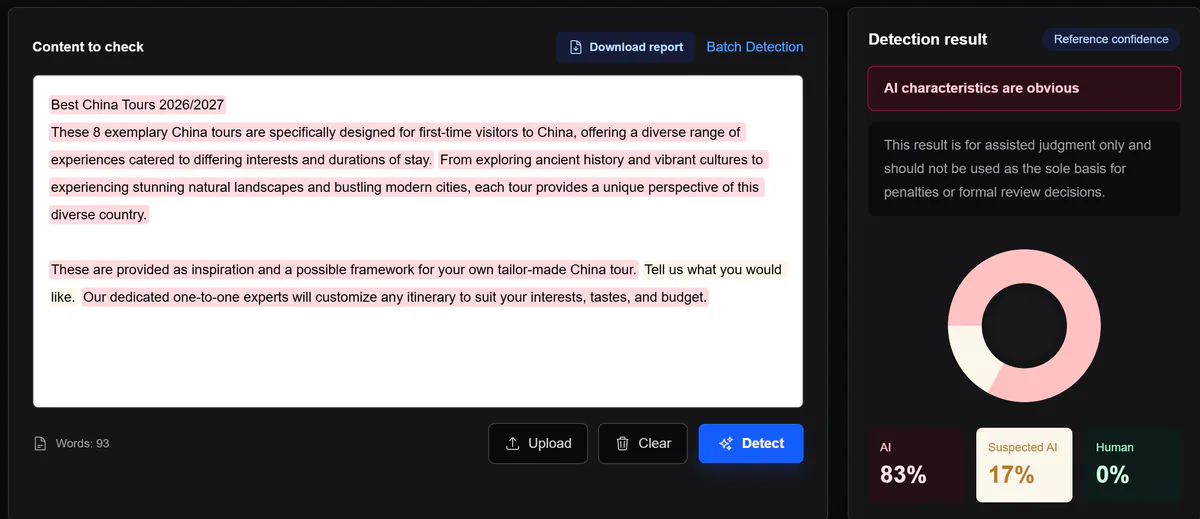
Text marked as AI shows stronger patterns commonly associated with AI-generated content. A higher AI score means the detector found more signals consistent with machine-generated writing.
Check whether your text is likely AI-generated or human-written with Unfox AI Detector. Get clear AI detection results with sentence-level analysis for content from ChatGPT, Claude, Gemini, DeepSeek, and other AI models.
A closer look at the language behind your detection result.
Preset sample; no model call. Real detection results request a separate analysis.
Built to check AI traces from ChatGPT, Claude, Gemini, and multilingual writing workflows






An AI detection score is a probability-based signal, not proof of who wrote the text. Unfox analyzes writing patterns across your content and shows how strongly different sections resemble AI-generated or human writing.
Text marked as AI shows stronger patterns commonly associated with AI-generated content. A higher AI score means the detector found more signals consistent with machine-generated writing.
Suspected AI indicates that the writing contains mixed or less conclusive signals. This can happen with heavily edited AI text, highly structured human writing, or content that combines human and AI-assisted writing.
Text marked as Human shows patterns more consistent with human-written content. This does not certify authorship, but indicates that the AI detector found fewer signals associated with AI-generated writing.
An AI content detector analyzes text to estimate whether it is more likely to be AI-generated or human-written. It looks for linguistic and statistical patterns commonly associated with AI writing rather than searching for copied text or specific words.
Unfox AI Detector helps you check for AI across essays, articles, reports, marketing copy, and other written content. It provides an overall detection result along with sentence-level signals, giving you more context than a single AI score.
Unfox uses AI detection models to analyze writing patterns and identify signals associated with AI-generated and human-written text.
The AI detector examines linguistic and structural patterns throughout the submitted text rather than judging individual words in isolation.
The system evaluates patterns such as predictability, sentence variation, and other statistical signals that may differ between AI-generated and human writing.
Unfox turns these signals into an overall AI detection result and sentence-level analysis, helping you identify which parts of the text may deserve closer review.
AI detection results are probability-based signals, not proof of authorship.
Get more than a simple AI check. Unfox combines detailed text analysis with practical tools for individual users, content teams, and larger workflows.
Go beyond one overall percentage. Unfox highlights sentence-level signals so you can quickly identify which parts of your text are more likely to contain AI-generated patterns.
Check writing from major AI models, including ChatGPT, Claude, Gemini, and DeepSeek. Unfox is designed to identify AI writing patterns across different generative AI systems.
Use the AI checker across 17 supported languages, including English, Chinese, Japanese, German, French, Spanish, Korean, and more.
Need to check more than one document? Use batch detection for larger content volumes or integrate the Unfox AI detection API into your own platform and workflow.
Whether you're checking your own writing, reviewing someone else's work, or managing content at scale, Unfox gives you a practical way to see where AI-generated patterns may appear.

Students can review essays, assignments, and other academic writing before submission. Educators can use AI detection as one additional signal when reviewing student work, especially when questions about authorship or AI assistance come up.

Check drafts, articles, and client work to see whether AI-assisted writing or editing may have changed the way the content reads. It can be useful as a final review step before delivering or publishing content.

Review blog posts, landing pages, outsourced articles, and other marketing content before they go live. Teams can use detection results to flag content that may need a closer look rather than relying on a simple AI or human label.

Scan submitted articles, manuscripts, and other written content for potential AI signals. Sentence-level results can help editors identify sections worth reviewing more closely.

For teams handling content across multiple clients, departments, or projects, Unfox can help bring AI detection into an existing review workflow. Batch detection and API access can make it easier to check larger volumes without adding a separate manual step for every piece of content.
Unfox AI detector supports 17 mainstream languages worldwide, providing accurate AI content detection results regardless of your language.
Enter text in any language and the system will automatically identify the language and provide precise AI detection results.
AI detection is not a simple yes-or-no judgment. Detection models look for patterns commonly associated with AI-generated writing, so results are best understood as signals rather than absolute proof.
Unfox continuously evaluates and refines its detection models as AI writing tools, editing techniques, and writing styles continue to change. Results can vary depending on factors such as text length, writing style, AI-assisted editing, paraphrasing, and highly structured or formulaic content.
A false positive happens when human-written content shows patterns that resemble AI-generated writing. This can sometimes occur with academic, technical, or highly structured text, where consistent phrasing and predictable patterns are more common.
That’s why Unfox is designed to give you useful evidence to consider—not a verdict to accept blindly. Use the result alongside the original writing, context, and your own judgment for a more informed assessment.
AI detection is most useful when it helps you review content with more context and confidence.
Unfox helps you spot sections that may deserve a closer look. Use the result as a helpful signal—not a final verdict on who wrote the content.
Checking an essay, client draft, or internal document? Your content is not stored after detection and is discarded after analysis.
Review multiple documents with Batch Detection, or connect the Unfox API when AI detection needs to become part of your own workflow.
Revise an AI-assisted draft, then review the wording and meaning before using it.
Check an image for signals of AI generation alongside its source and context.
Check audio for signals of synthetic speech. A detection result is not proof of authenticity.
Curious about AI detection? Explore practical guides to help you understand AI detection and make better use of your results.

Learn why AI detectors flag human writing, how false positive rates vary, and what detection scores really mean.

Learn how accurate AI detectors are, what affects reliability, and how to interpret false positives and AI scores.

Compare AI-generated text and human writing, including key differences, detection limits, and fair content review methods.

Learn how AI content detectors analyze writing patterns, calculate scores, and why their results are not definitive.
Learn how to detect AI-generated text using AI detectors, writing patterns, fact checks, and contextual evidence.

Results vary widely by tool and detector, and rewriting carries costs the pricing pages leave out. What to check before you use one.
In a test set of millions, our AI detector's false positive rate is below 0.2%.
The AI checker trusted by users worldwide.
We never store your content. It is immediately discarded after detection. Your privacy is safe the moment you hand it to our AI content detector.
Writers, educators, and content teams rely on Unfox to review AI-generated text with clarity.
"I run student essays through Unfox before I review them, and it still catches lightly rewritten AI sections without overreacting to normal edits."

"For our SEO team, the AI content detector is a fast first pass. It helps me catch filler paragraphs before they reach publish."

"The confidence score gives me a clear starting point. It is much easier to triage a long article with a signal like that."

"We work in two languages, and Unfox has been surprisingly consistent on both English and Chinese drafts. That matters in localization review."

"The privacy-first workflow is a big deal for us. I can check client copy and internal docs without worrying about content being retained."

"When writers use AI for brainstorming, I still need to know which sections need a human rewrite. This makes editorial review faster."

"I tested it on paraphrased, polished text and it still surfaced the patterns I was looking for. That is the signal I need in QA."

Here are answers to some of the questions we hear most often.
Unfox analyzes linguistic and statistical patterns to estimate whether text is more likely to be AI-generated or human-written. Like any AI detection tool, it cannot guarantee 100% accuracy. Results can vary depending on text length, writing style, paraphrasing, AI-assisted editing, and other factors. We recommend using the detection score and sentence-level results as signals for further review rather than definitive proof of authorship.
Yes. AI detectors can produce both false positives and false negatives. Human-written content may sometimes show patterns associated with AI, particularly when the writing is highly structured, formulaic, or heavily edited. Similarly, AI-generated text may not always be identified correctly. For this reason, an AI detection result should be considered alongside the writing context, source material, and other available evidence.
Yes. Unfox is designed to identify AI writing patterns associated with major generative AI systems, including ChatGPT, Claude, Gemini, and DeepSeek. AI models continue to evolve, so detection systems also need to adapt to new writing patterns. Results indicate how strongly submitted text resembles AI-generated writing rather than proving which specific model created it.
An AI detection score represents how strongly the submitted text shows patterns associated with AI-generated writing. A higher AI score indicates stronger AI-associated signals, while a higher Human result indicates patterns more consistent with human writing. The score is a probability-based signal, not a definitive statement about authorship. Sentence-level results can provide additional context by showing which parts of the text contributed to the overall result.
Yes. Unfox can analyze text at the sentence level, which helps identify sections that show stronger AI-associated patterns within a larger document. This can be useful when human-written content has been combined with AI-generated or AI-assisted passages. However, mixed writing can be more difficult for any AI detector to classify consistently, so individual sentence results should still be reviewed in context.
Yes. Unfox can be used to review essays, assignments, papers, and other academic writing for patterns associated with AI-generated content. Students can use it as a self-check before submitting work, while educators can use it as one input during content review. AI detection should not be used alone to determine academic misconduct or make decisions that could significantly affect a student's academic standing.
Unfox is designed to make AI detection accessible without unnecessary steps. If your current free detector allows users to run a check without creating an account, you can paste or upload your content and start the detection directly. Any usage limits or account requirements should be clearly shown in the detector interface so users know what to expect before running a check.
Unfox is designed with a privacy-first detection workflow. According to the current product policy, submitted content is not stored after detection and is discarded after analysis. This allows users to review essays, unpublished articles, client drafts, and other sensitive content with greater confidence. For specific retention, security, or enterprise requirements, users should also refer to Unfox's current privacy and data-handling policies.
Unfox supports AI detection across 17 languages, including English, Simplified Chinese, Japanese, German, French, Spanish, Portuguese, Russian, Arabic, Dutch, Czech, Hindi, Indonesian, Italian, Korean, Turkish, and Vietnamese. The system can identify the language of supported content and analyze it for patterns associated with AI-generated writing.
No. An AI detector can estimate whether text contains patterns associated with AI-generated writing, but it cannot establish who actually wrote the text or prove that a specific person used AI. Detection results are best used as one part of a broader review that may include writing history, drafts, source material, and other relevant evidence.
Use the AI detector today and take the truth of your content back into your own hands.
No credit card required.